
THE HUMAN-AI FLYWHEEL || When Keeping Humans in the Loop Becomes Your Competitive Advantage

Few topics generate more anxiety in professional circles right now than AI and job displacement.
Scroll through any business feed, and the narrative is consistent: AI is coming for your job, your team, and eventually your entire department. The fear is understandable. Automation is accelerating, budgets are tightening, and the pressure to deploy AI solutions quickly has never been higher. But after spending time at Web Summit Vancouver 2026, I'm convinced the most interesting story isn't about replacement. It's about what happens when companies get the balance wrong, and what the smarter ones are building instead.
At the conference, I sat down with Sebastião Zaragoza, co-founder of GetVocal AI, a conversational AI platform operating across 22 countries and 55 languages. GetVocal builds AI agents for telecoms, banks, insurance companies, and healthcare providers, ranging from small businesses to large enterprises. What makes Zaragoza's perspective worth paying attention to is the timeline. GetVocal launched three years ago, which means the company has lived through the full arc of the industry's shifting attitudes toward automation.
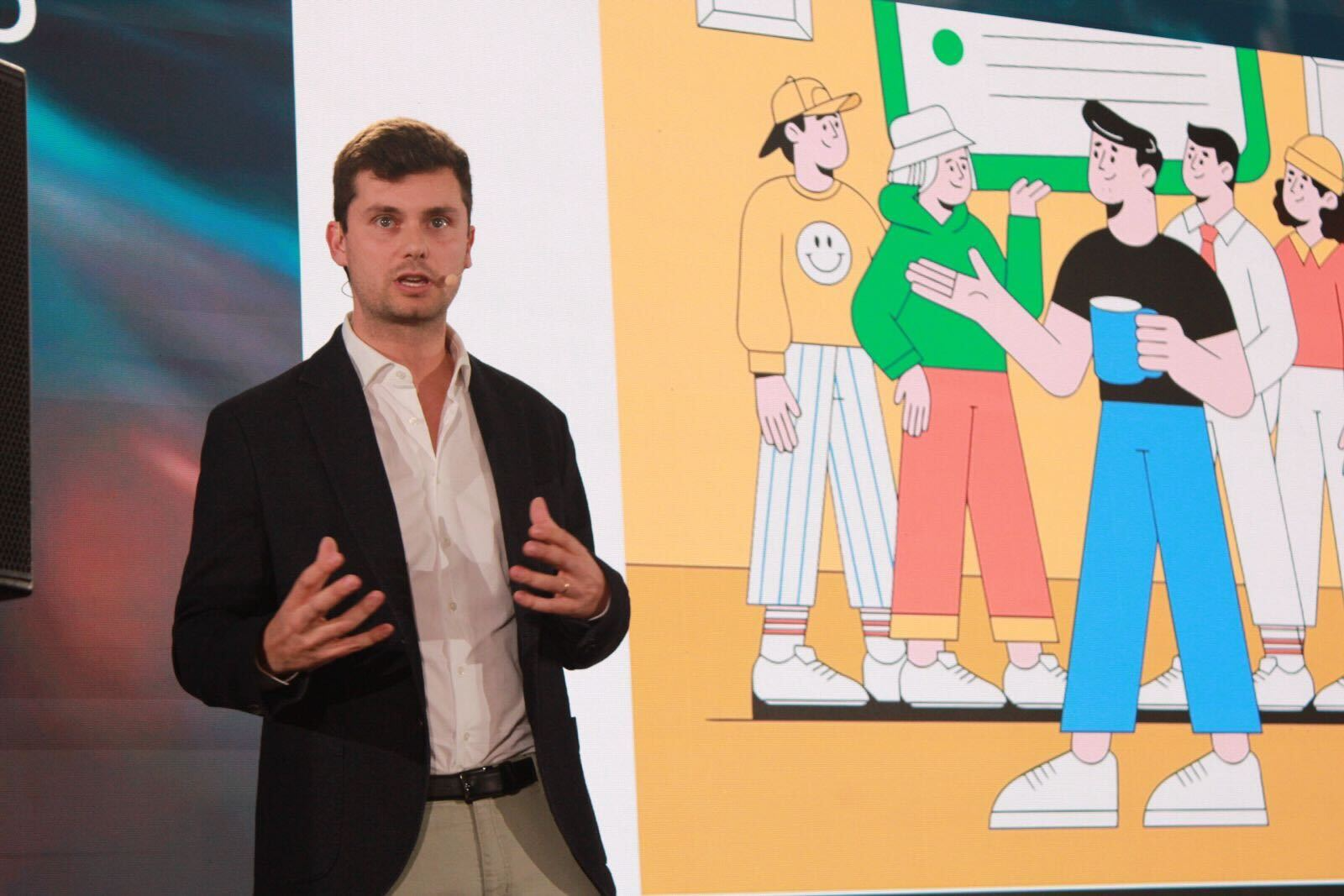
Sebastião Zaragoza, Co-founder of GetVocal AI. Photo courtesy of GetVocal AI
Three years ago, the conversation was straightforward: businesses wanted as much AI as possible, as fast as possible. Today, Zaragoza tells me those same businesses are calling back with a completely different request. The question that kept surfacing in GetVocal's early customer interviews wasn't how to automate everything. It was something more cautious: "How do I make sure AI says the right thing in the right moment? How do I make sure that AI is respecting my processes, the ones that I created 10 years ago, 20 years ago?" That question, it turns out, was the right one to be asking all along.
“How do I make sure AI says the right thing in the right moment? How do I make sure that AI is respecting my processes, the ones that I created 10 years ago, 20 years ago?”
GetVocal's answer is what Zaragoza calls a gradual deployment model, and it's meaningfully different from the full-automation approach that many competitors still advocate. Rather than switching on an AI agent across all customer interactions at once, GetVocal starts narrow. As Zaragoza explains: "I'll start with a specific problem with a specific query, I'll solve that. Whenever it's too much or too complex, I transfer to a human. But when I transfer, I'm recording. I know what's happening, and I'm training the AI agent." Every handoff becomes a data point. Every escalation is a lesson. The system gets smarter not in spite of its limitations, but because of them.
Central to this model is a feature GetVocal calls the Control Tower, a dashboard that gives human operators full visibility into every conversation. Operators can monitor interactions in real time, jump into any call that feels off, and validate how the AI agent should handle similar queries in future. The humans aren't just a safety net; they are active contributors to the system's evolution. It's a structure that entirely reframes the conversation about the workforce.
This is where the human-AI flywheel argument becomes most compelling. Rather than asking how many human roles AI can eliminate, the more productive question is which tasks humans are uniquely positioned to handle and how AI can free them to focus on them. Zaragoza is direct about it: "I think humans need to keep judgment. And whenever you implement these type of solutions, your teams, they need to act as the teachers or judges for what the AI says." In practice, this means redundant, repetitive queries get resolved by the AI agent, while complex, sensitive, or ambiguous cases are escalated to operators who are better equipped to handle them.
“I think humans need to keep judgment. And whenever you implement these type of solutions, your teams, they need to act as the teachers or judges for what the AI says.”
The companies that will come out ahead in this shift are not necessarily those with the most sophisticated AI. They are the ones who deliberately design the human-AI relationship, building systems in which each makes the other more effective. That's a harder product to demo, but it's a far more durable one to deploy.