DECOCER LYTHOS || A Mediterranean Pavement Tradition, Reimagined in Porcelain
Long before a room reveals its furniture or its light, the floor has already spoken, and in Mediterranean courtyards, galleries, and homes, that language was geometry.
For centuries, stone pavements across the region did more than support foot traffic; they organized space, guided movement, and set the emotional register of a place before a single wall was noticed. It's one of design's quieter truths: we touch the floor first, and it decides how we feel about everything built above it.
DECOCER's new LYTHOS collection returns to that tradition with a contemporary geometric floor tile system in porcelain. Rather than replicate historic stone underfoot, the collection distills its compositional logic, repetition, proportion, and geometric precision into a design tool built for how architects and interior designers actually work today. The reference point is the pavement language of Mediterranean courtyards, galleries, and squares; the execution is entirely current and built for small-format ceramic construction rather than quarried stone.
Star and cross geometries in Dark Grey anchor this sun-washed courtyard, terracotta coffee tables and a woven basket softening the pattern's graphic precision.
The same composition rendered in a lighter Grey shifts the mood entirely, letting the arched walls and olive-toned plantings take the lead.
That system rests on four interlocking geometries: octagon, star, cross, and insert. Each can be combined with the others to generate a wide range of configurations, from restrained, near-monochrome fields to more graphic, high-contrast layouts. It functions less like a single tile pattern and more like a design toolkit, one that lets a floor's visual intensity flex with the character of the room it enters, quiet underfoot in a bedroom, more assertive across an entry, courtyard, or hospitality lobby where a stronger first impression is welcome.
Colour plays a deliberately supporting role. LYTHOS comes in four tones: White, Sand, Grey, and Dark Grey, inspired by the understated variation of natural stone rather than reproducing it literally. The restraint is intentional: a muted palette keeps the geometry legible and lets the collection sit comfortably in projects ranging from minimalist interiors to more textured, layered spaces, without ever competing with the furniture, textiles, or finishes built around it.
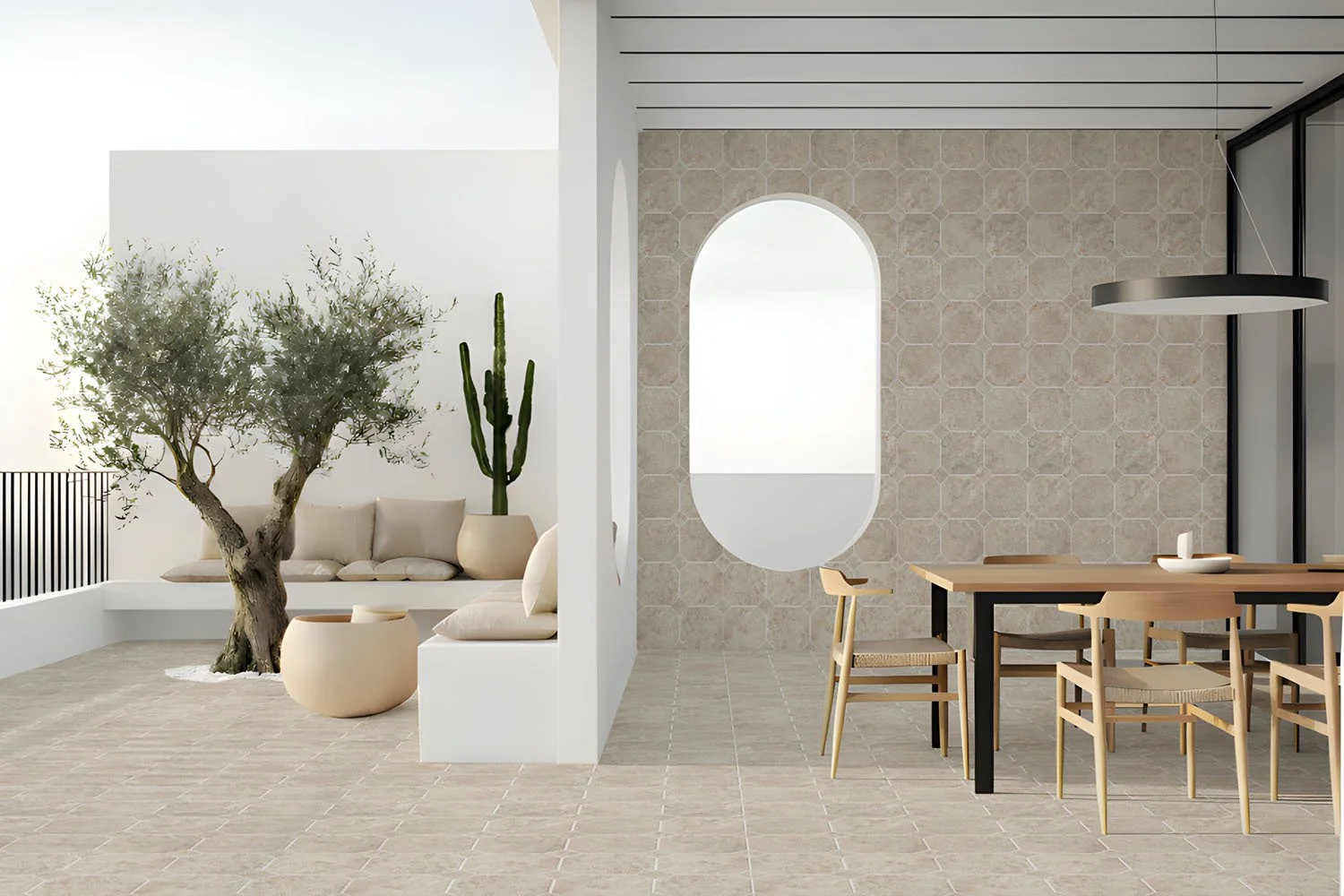
Carried up the wall in Sand, the octagon pattern frames an oval mirror and dining nook, proof that LYTHOS reads as comfortably vertical as it does underfoot.
Practically, LYTHOS is built for real use. The porcelain body carries a mineral matte finish and C3 slip resistance, meaning it performs as confidently on an open-air terrace as it does inside a hallway or hospitality lobby. That indoor-outdoor continuity matters more than it might first seem: a courtyard and the room it opens onto can now speak in the same material language, uninterrupted by a threshold or a change in finish underfoot. Behind the collection sits DECOCER, a small-format ceramics specialist with more than 35 years developing tailor-made tile solutions for residential, hospitality, and contract projects across more than 20 countries.
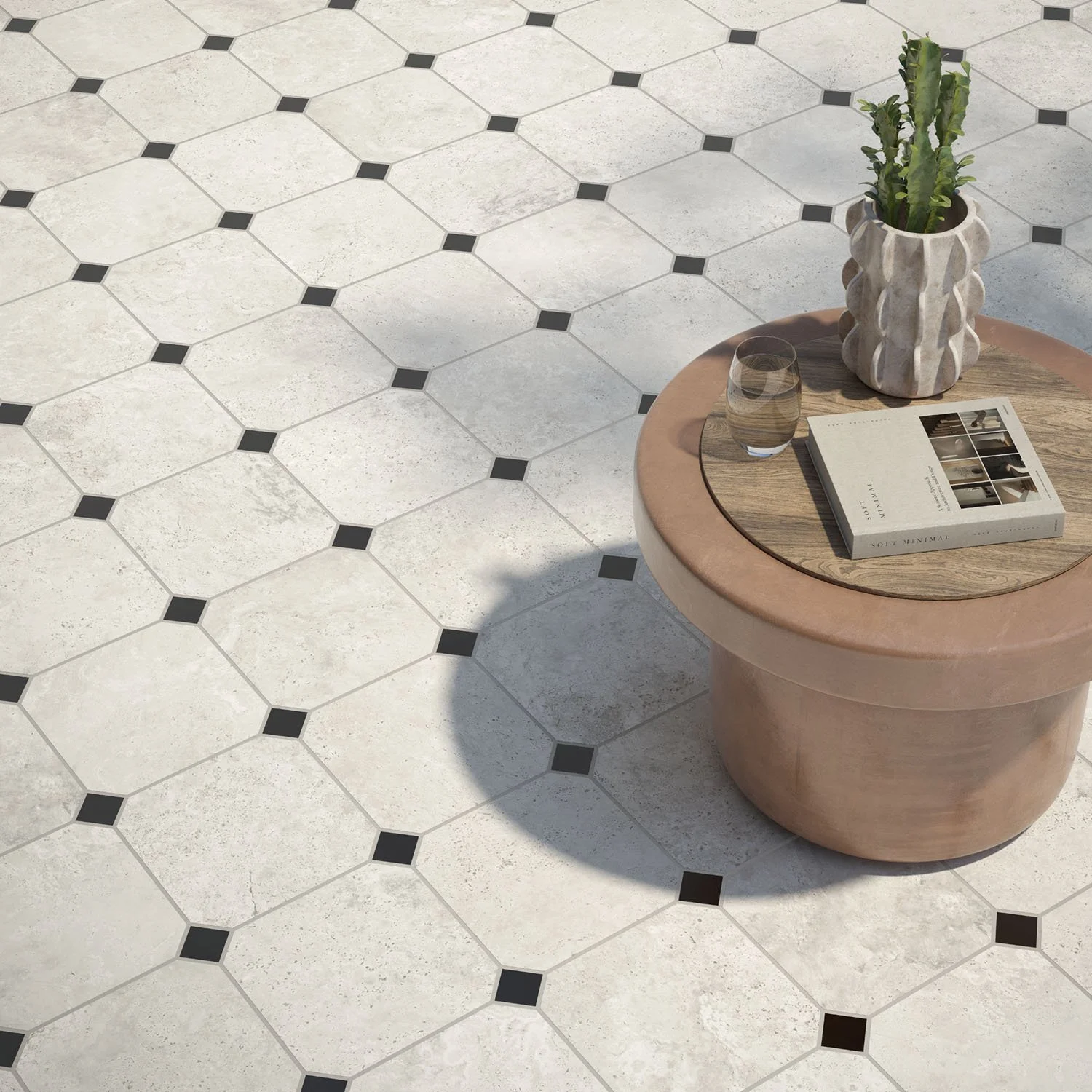
A close view of the White and Black insert pairing reveals the crisp geometric rhythm that gives LYTHOS its architectural presence.
There's a case to be made that flooring is the most under-considered decision in a room, chosen late, often reactively, after walls and furniture have already claimed the design conversation. LYTHOS argues for the opposite order, treating the pattern underfoot as a starting point for a space's identity rather than an afterthought layered in once everything else is settled. Treat the floor as a foundational decision rather than a finishing one, and the geometry underfoot stops being a backdrop and starts being architecture, setting the tone for a room, a courtyard, or an entire home.