
LIVING WELL IN 20 SQUARE METRES || Cabin Devín Demonstrates the Intelligence of Off-Grid Design
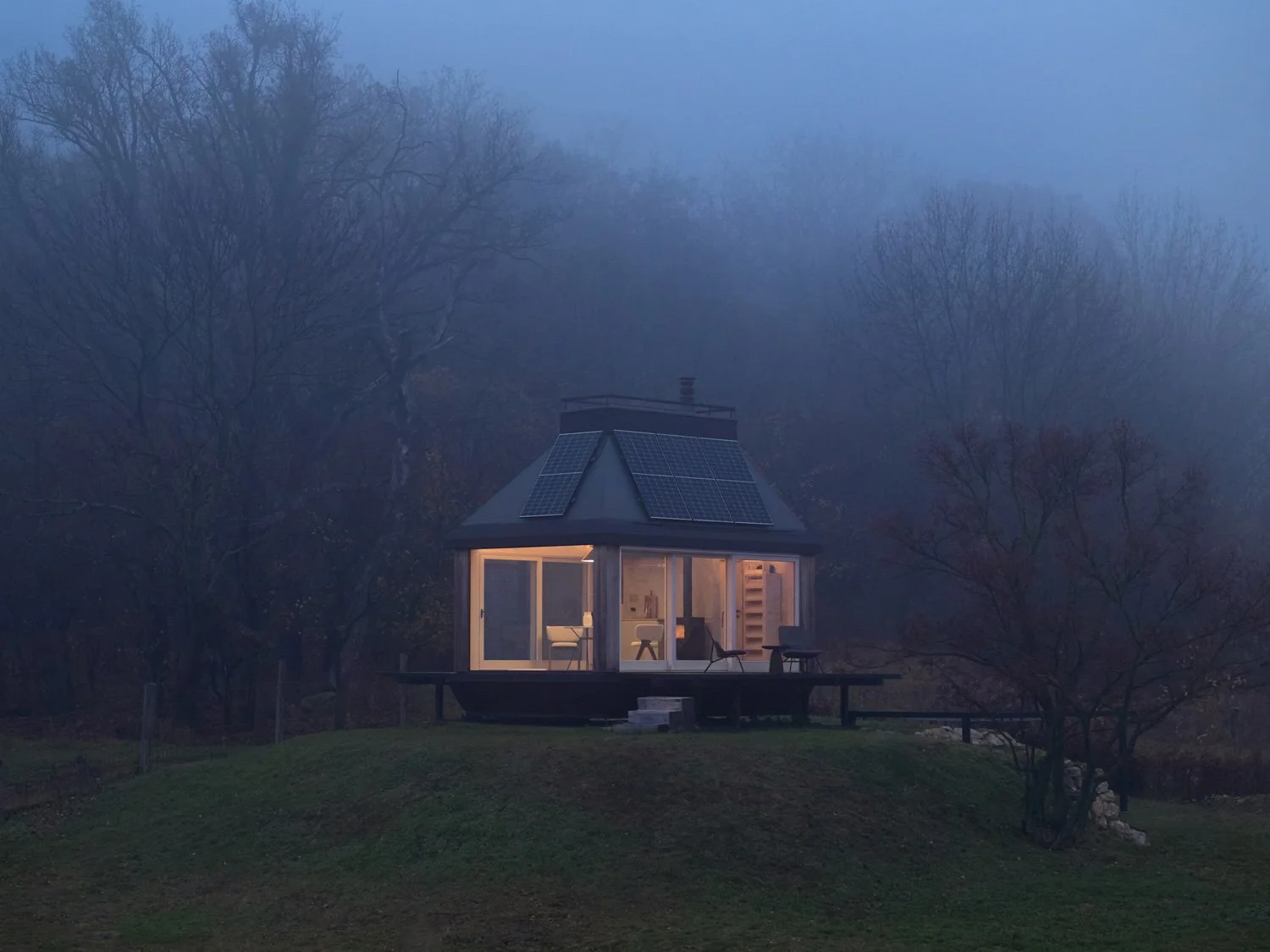
Not every retreat needs a sprawling footprint to feel complete.
Overlooking the vineyards above Devín, this compact cabin compresses the rituals of daily life into a carefully orchestrated sequence of spaces that expand, transform, and reconnect the occupant with the surrounding landscape.
Cabin Devín sits above the Zlatý Roh vineyards near Bratislava, where fold-down terraces and panoramic glazing connect the compact structure directly to the surrounding landscape.
Set at the edge of the Zlatý Roh vineyards, just above the historic silhouette of Devín Castle near Bratislava, the cabin occupies a site defined by long horizons and shifting atmospheres. Morning fog drifts across the vines, while evenings open onto sunsets stretching toward the Austrian Alps. In such a setting, the architects from Ark-Shelter and Archekta approached the project with restraint, asking how a dwelling of only 20 square metres could feel both protective and expansive.
Their answer lies in architecture that transforms rather than enlarges.
Two sides of the cabin unfold outward into terraces that hinge down from the façade, creating outdoor platforms suspended above the slope. Once lowered, sliding glass walls reveal a living space that dissolves almost entirely into the landscape. When fully opened, the terraces extend the interior outward, effectively multiplying the usable living area and blurring the boundary between shelter and nature. Most of the cabin’s daily life takes place within this threshold zone, where interior comfort meets open air.
Operable terraces unfold from the façade to expand the living space outward, creating an open pavilion that blurs the boundary between interior and vineyard views.
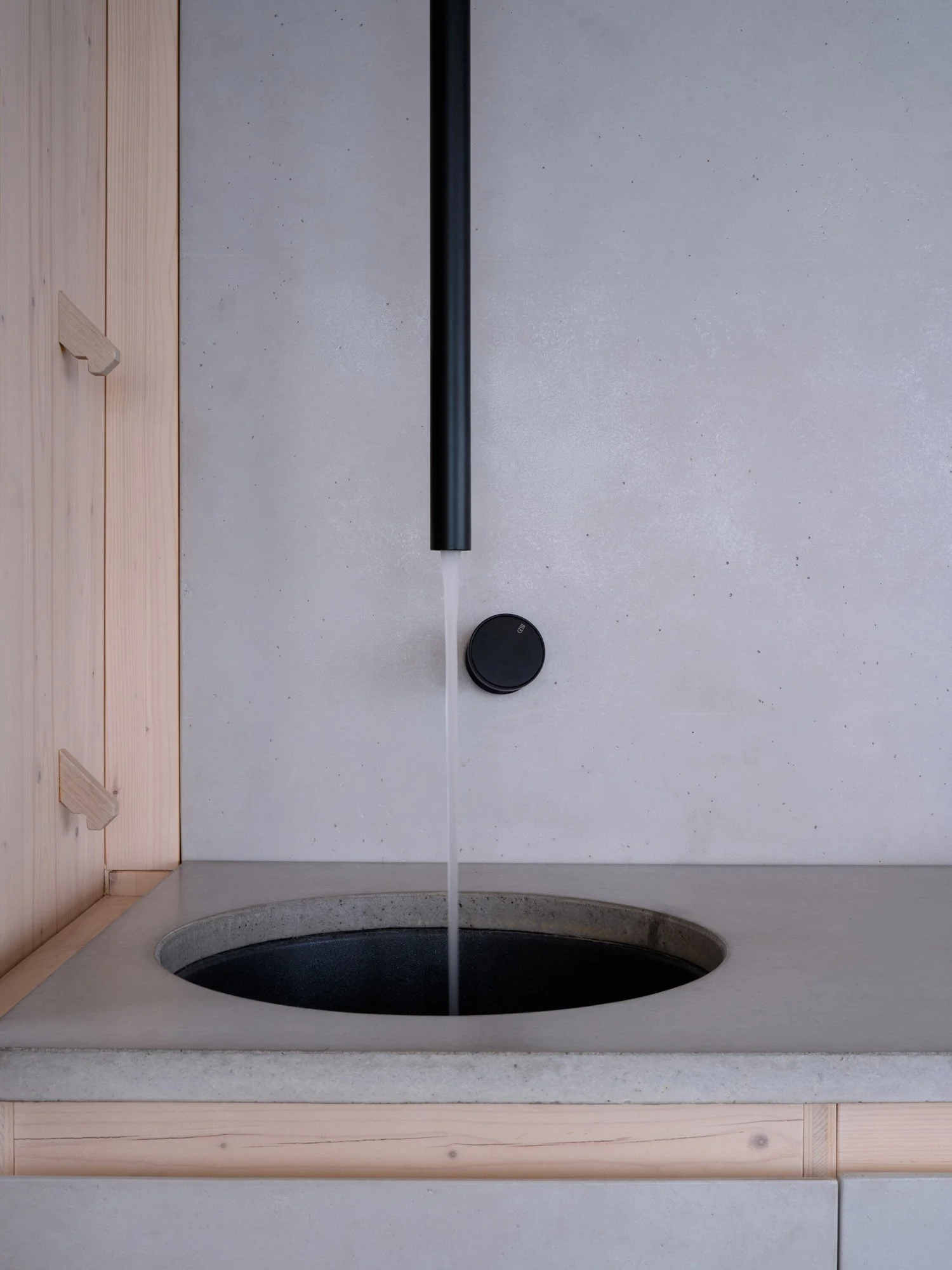
Inside, the atmosphere shifts from openness to intimacy through a careful sequence of compact functions. A small dining area sits beside floor-to-ceiling glazing, framing the surrounding vineyards as a living backdrop. Behind it, a minimalist kitchenette and integrated cabinetry conceal storage and appliances within pale timber surfaces. The materials remain deliberately restrained, allowing the view beyond the glass to become the dominant element of the interior.
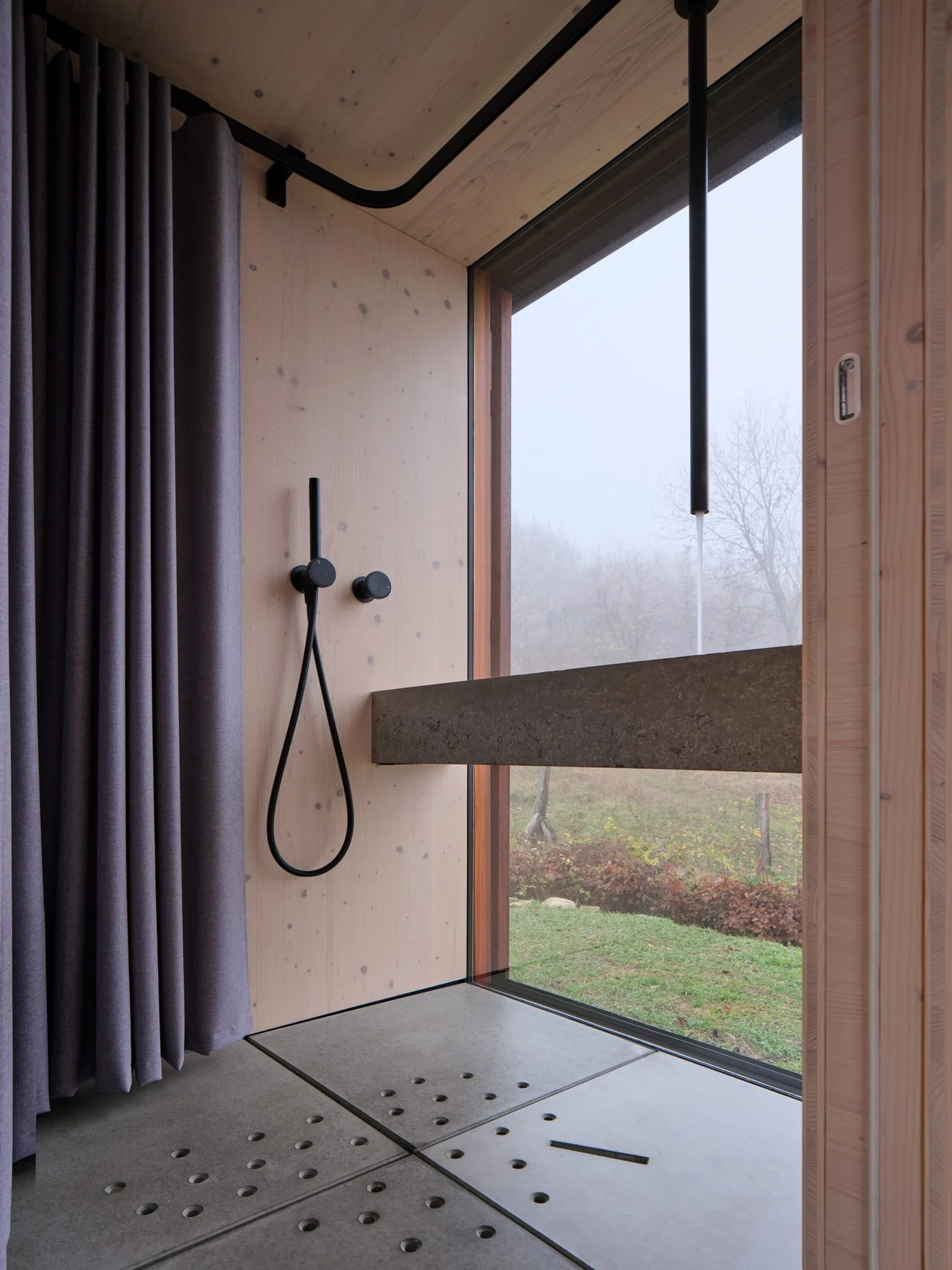
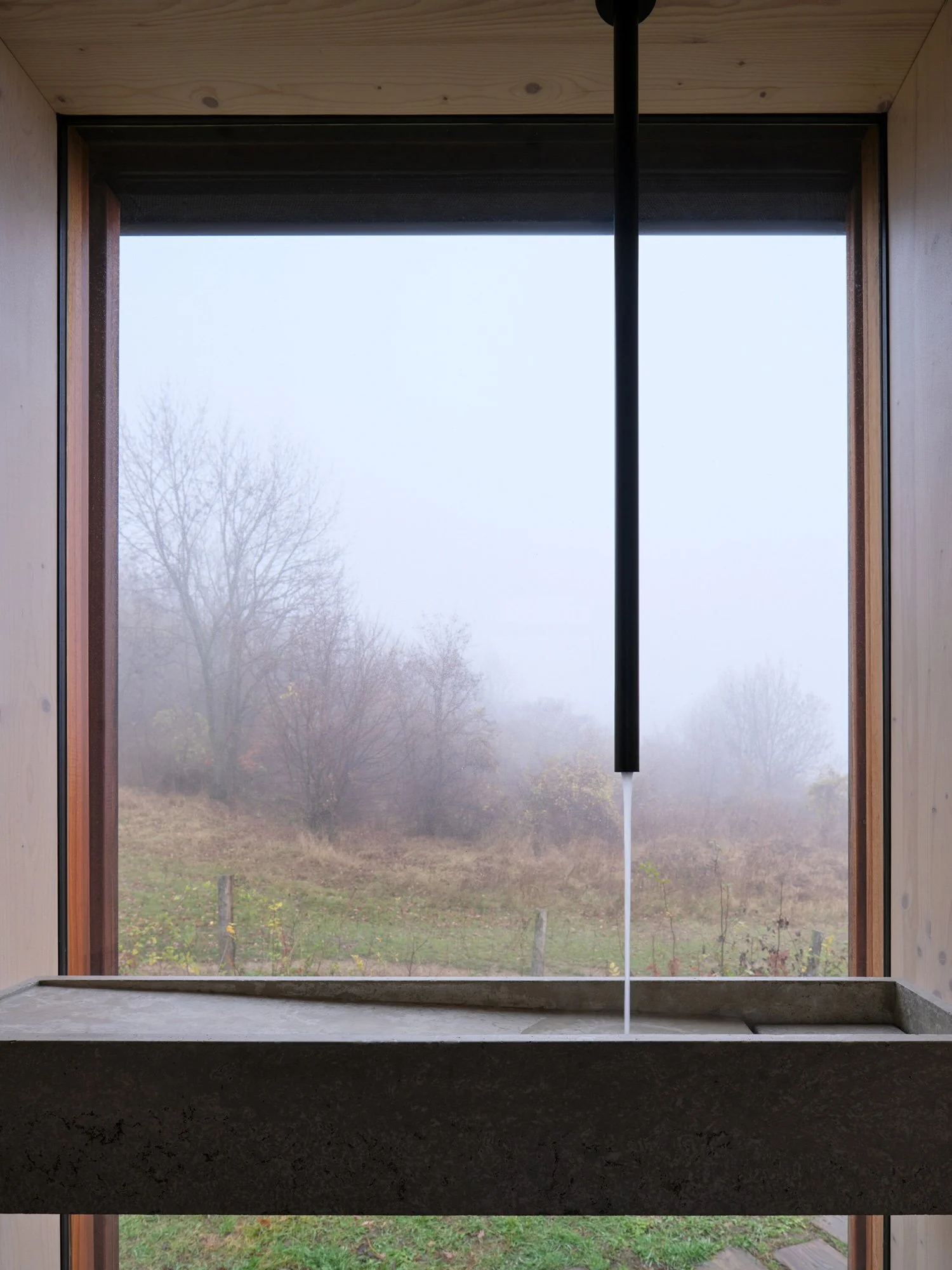
One of the cabin’s most thoughtful gestures appears in the bathroom, where a cast concrete sink is positioned directly within a window frame. The placement transforms an ordinary act such as washing one’s hands into a moment of quiet observation, encouraging occupants to slow down and reconnect with the landscape beyond.
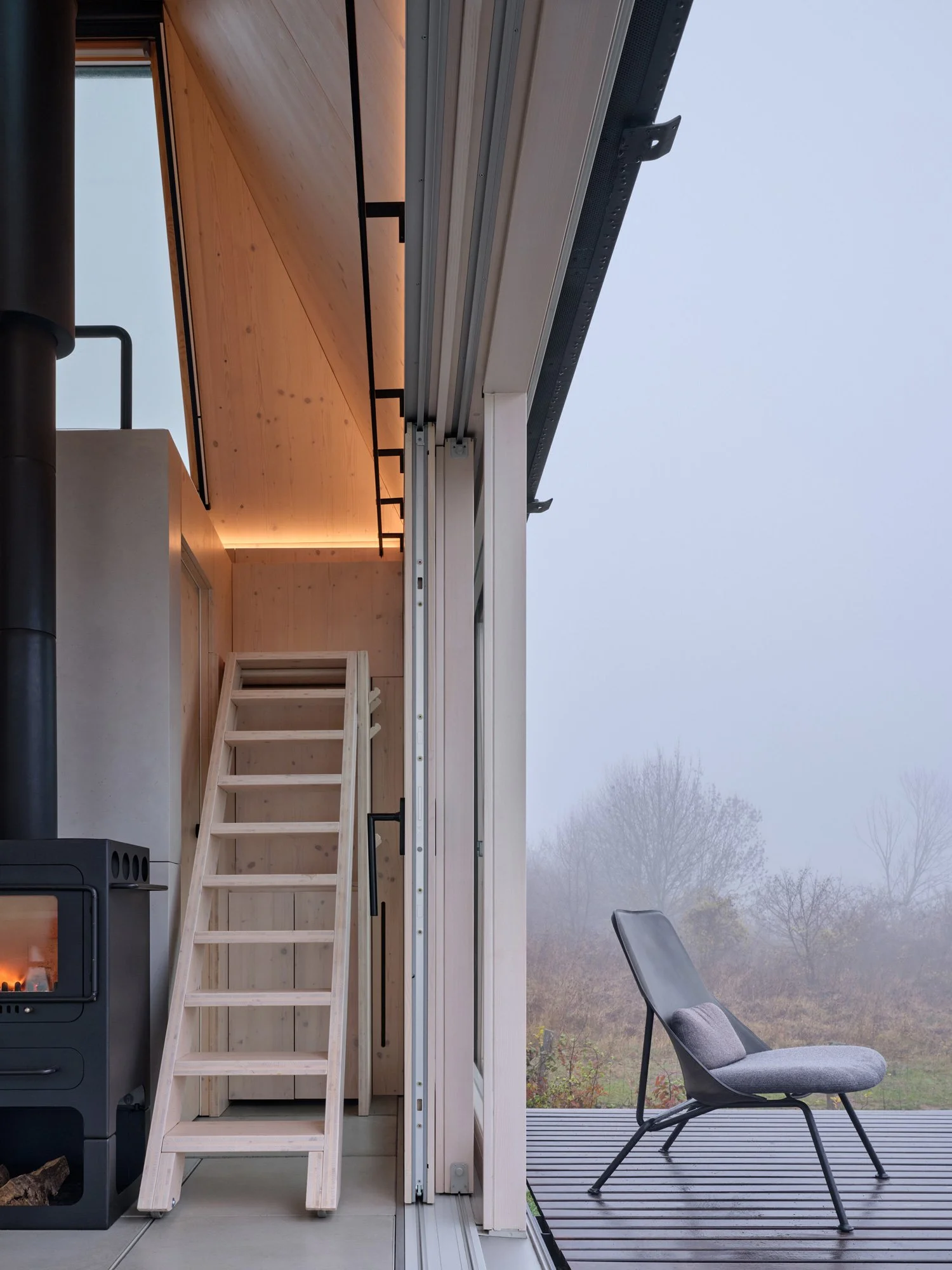
Above the main living area, the sleeping loft remains discreet during the day. A pendant lamp suspended from the ceiling doubles as a subtle mechanism; when its cable is pulled, it rises upward to reveal the loft space concealed above. Access is provided through a retractable ladder integrated into the cabinetry, maintaining the visual clarity of the small interior when the ladder is not in use. Unlike the glass-lined living area below, the loft is enclosed within the solid roof volume, creating a sheltered atmosphere that culminates in a skylight positioned for stargazing.
A concealed sleeping loft sits above the living space, while a wood-burning stove anchors the interior with warmth during colder seasons.
Despite its modest scale, the cabin operates as a fully autonomous dwelling capable of functioning throughout all four seasons. Photovoltaic panels supply energy to battery storage, while a gas backup system ensures reliability during periods of limited sunlight. Hybrid appliances automatically switch between power sources, prioritizing electricity for lighting and small devices while allowing heating and other energy-intensive processes to adapt to available resources. Water is stored in reservoirs concealed beneath the raised floor, alongside a separate wastewater system.
Positioned within the glass envelope, the dining corner frames expansive views across the surrounding vineyards and hills. The retractable pendant light above can be lowered for an intimate dining ambiance.
Environmental comfort is managed through passive and intelligent strategies. Shading screens protect the glazing from summer heat, while controlled ventilation draws cooler air from beneath the structure and releases warm air through a heat recovery unit near the skylight. Sensors monitor carbon dioxide levels and humidity, adjusting the indoor environment to maintain a comfortable climate without unnecessary energy consumption.
The cabin emitting a soft glow amidst the dense fog.
What emerges from these carefully integrated systems is a dwelling that feels far larger than its footprint suggests. Through movable terraces, concealed spaces, and thoughtful environmental design, Cabin Devín demonstrates that the future of compact living may not lie in building bigger homes, but in designing smarter ones.
In the quiet above the vineyards, this small structure offers a compelling reminder that architecture need not be vast to create a complete world.
PROJECT DETAILS
Studio
Author: Martin Mikovčák, Viktor Mikovčák
Studio address
Rosalialaan 49, 8810 Lichtervelde, Belgium
17. novembra 2868, 022 01 Čadca, Slovakia
Co-author: Barbora Šimášková, Ondrej Vavro, Radovan Hnidka
Project location: Devín, Bratislava
Project country: Slovakia
Project year: 2023
Completion: 2024
Built-up area: 20 m²
Usable floor area: 14,7 m²
Dimensions: 5,4 × 3,7 × 5,1 m
Client: Cabin Devín
Photographer: BoysPlayNice
Collaborators and suppliers
Structural engineer: Radovan Hnidka
Carpenter: Mário Cyprich
Realization of the module and built-in furniture: Ark-Shelter
Artworks: Stanislav Mikovčák
Glass: VAK
Loxone system and solar panels: PV SERVICE PLUS