MR. BELVEDERE || One Lot, Two Structures, Infinite Configurations
When the world stopped in 2020, one Seattle family didn't just wait it out; they used the pause to ask a harder question: what should a home actually be prepared for?
The answer, designed by Linework Architecture on a through-lot in Northeast Seattle, is a remodel and addition to an unassuming 1940s ranch that quietly reimagines what a single-family home can hold. Not just in square footage, but in possibility.
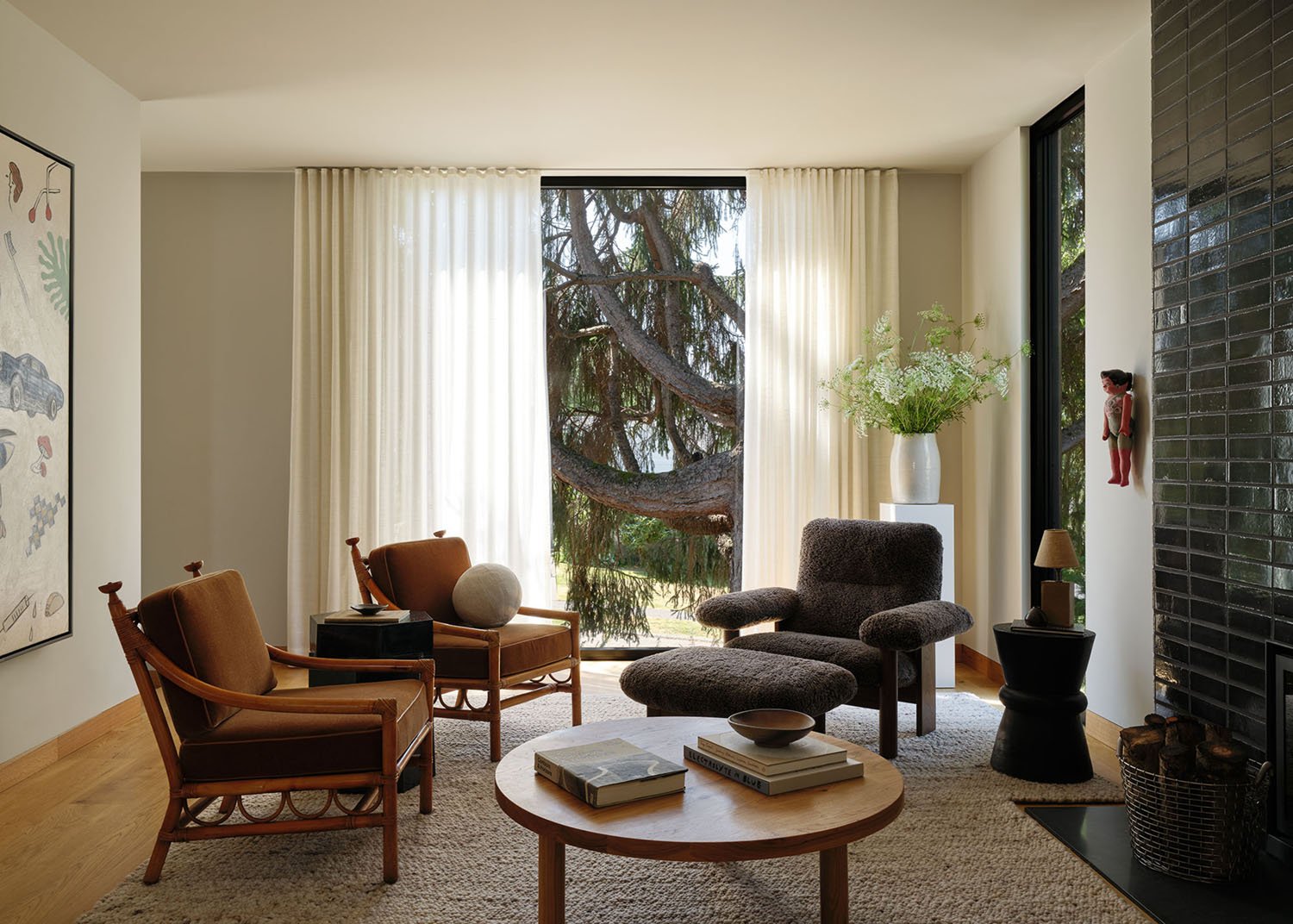
A boucle lounge chair and dark brick fireplace anchor the living room, where a slim vertical window frames the neighbouring roofline and tree canopy beyond.
The project introduced a new garage and detached accessory dwelling unit (DADU) at the rear of the property, creating a two-structure compound on a single lot. Currently functioning as one cohesive home for a nuclear family, the design is programmed to shift. The DADU's upper level operates as a family room; the lower level serves as a flexible workspace. Both could be reconfigured as a self-sufficient rental unit, an independent suite for an aging parent, or a private residence for the owner's handicapped brother. The architecture doesn't prescribe a single way of living. It holds space for several.
Large sliding glass doors open the dining area directly to the central garden court, with a built-in oak bookshelf marking the threshold between living and working spaces.
The spatial logic draws from the owner's experience living in a Japanese temple complex, where discrete structures relate through shared courtyards and gardens rather than connected corridors. Here, that influence manifests in a central garden court formed between the two buildings. Large sliding glass pocket doors open each structure to this shared outdoor space, dissolving the boundary between inside and out. Functions are intentionally distributed across both buildings, nudging occupants outside and into contact with the landscape throughout the day.
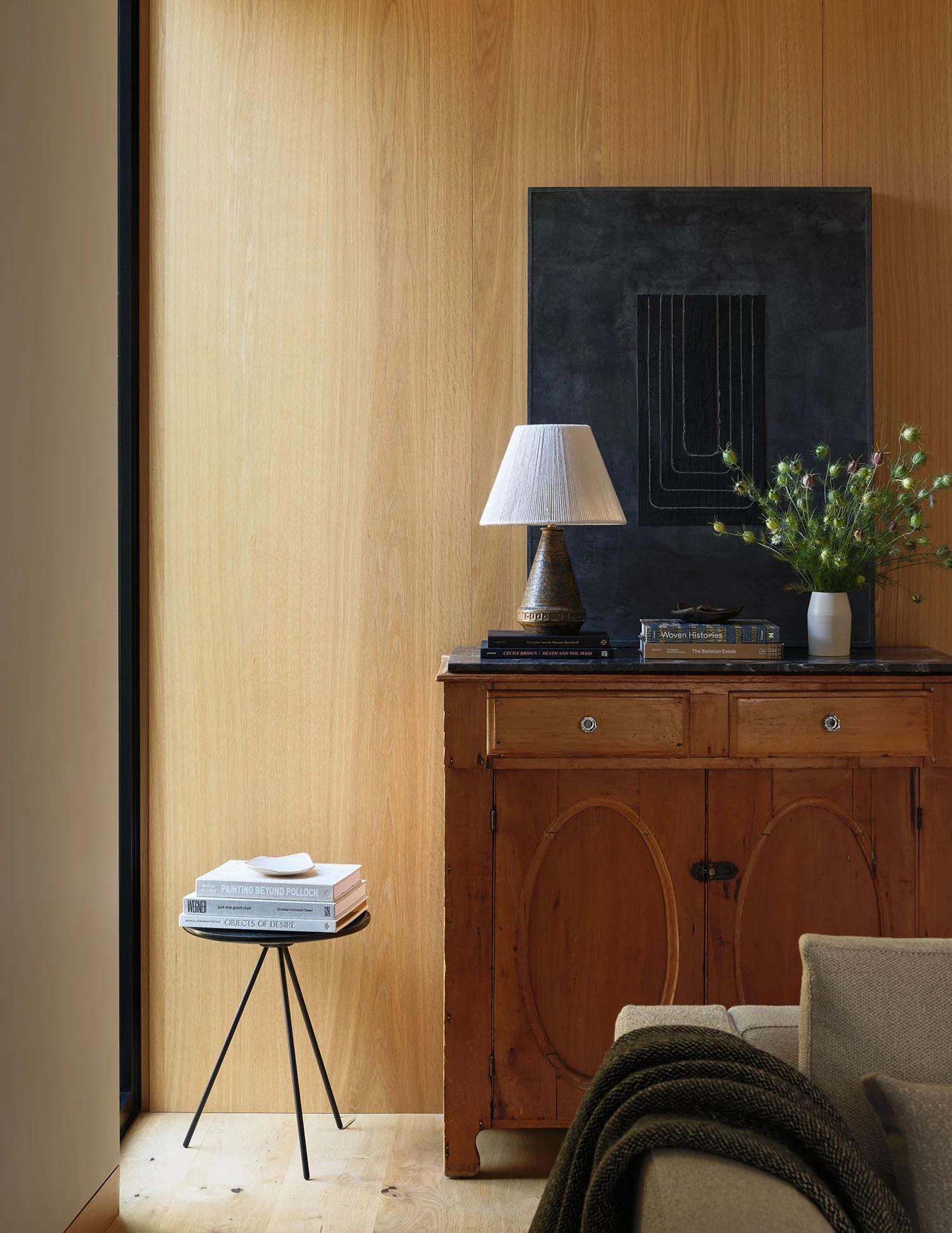
An antique pine sideboard sits against white oak panelling, layered with art books, a ceramic lamp, and a dark abstract work that echoes the room's restrained material palette.
At 2,250 square feet across both structures, the home is deliberately modest. The main house is 1,600 square feet; the DADU adds 650. That restraint is load-bearing. By building small and building durably, Linework reduced the home's annual energy use to a verified 3,800 kWh—a 73% reduction from the national average. The house runs on 100% electrical power, supported by a 15kW solar array. Both structures are conditioned and heat water with a heat pump. The main house is ventilated with a heat recovery ventilator, and the exterior envelope is clad in thermally treated wood that requires no recoating, paired with high-performance U-0.23 windows.
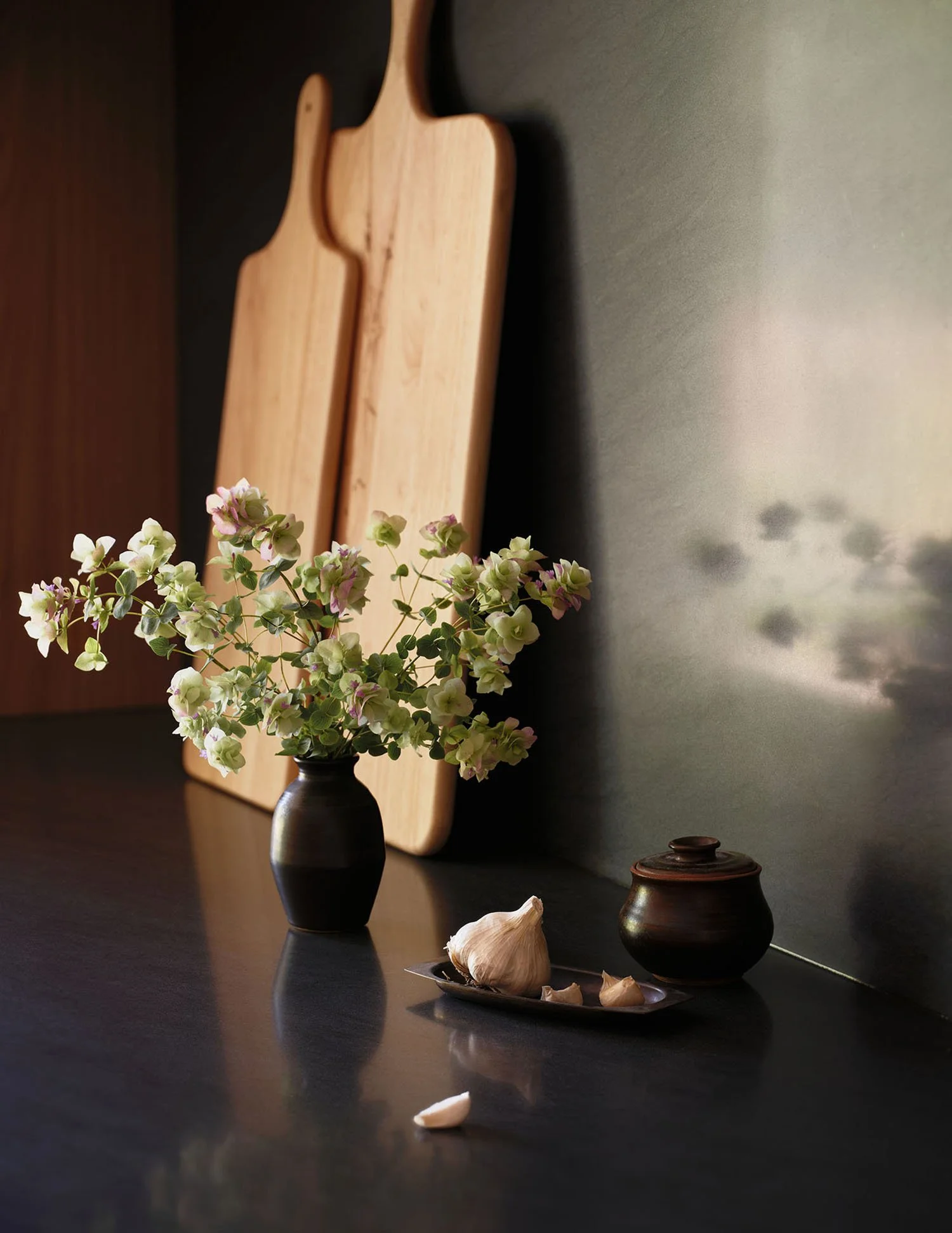
White oak cabinetry and open shelving frame a black honed backsplash in the expanded kitchen, where the line between storage and display is deliberately blurred.
The owners weren't pursuing formal certification. They were pursuing something more practical: a home that performs well, lasts long, and doesn't cost the planet more than necessary. The result demonstrates that meaningful sustainability doesn't require a platinum plaque. It requires intention, applied consistently across every decision.
Inside, the material palette reinforces this ethos without announcing it. White oak millwork runs through the kitchen and living spaces, grounding the interiors in warmth and continuity. The kitchen pairs black honed countertops with open shelving, ceramic vessels, and an ease of composition that feels curated rather than decorated. Bedrooms are calm and considered; the primary bathroom reads almost meditative, with stacked white tile, a skylit ceiling, and terrazzo underfoot.
The primary bedroom opens directly onto the central garden court through floor-to-ceiling glazing, with the solar-panelled DADU roofline visible across the shared outdoor space.
Mr. Belvedere doesn't perform flexibility. It embeds it into the site plan, the structure, the systems, and the daily rhythms of the people who live there. In a moment when households are changing shape faster than floor plans can keep up, that kind of foresight is its own form of design excellence.
From the garden court at dusk, the full extent of the remodel reveals itself: two darkened structures open to each other and to the landscape, held together by light and the space between them.
PROJECT DETAILS
Project: Mr. Belvedere
Location: Seattle, Washington
Architecture: Linework Architecture
Landscape: Alchemie
Builder: Linework Architecture
Photography: Kevin Scott