ALLEGATO || A Travelling Soul Finds Stillness in This Toorak Renovation Built on Cultural Memory
There are homes built for living in, and there are homes built for returning to; Allegato, a Toorak renovation by Robin Bliem & Associates and Grounded Gardens, was always meant to be the latter.
Designed for a couple returning home after years abroad, the project carries a clear philosophical brief: to create a place that could hold a life's worth of memory, culture, and belonging. The architecture takes its name and spirit from the Māori concept of Wairua, the idea of a travelling soul that has moved through the world and finally finds stillness. In that framing, every design decision becomes less about aesthetics and more about arrival.
A large-scale abstract work anchors the white pozzolan brick wall in the living room, where sliding glazed doors dissolve the boundary between interior and courtyard.
The L-shaped plan anchors the house around a central courtyard, orienting the dwelling for improved northern light, privacy, and spatial flow. This form is not incidental; it reflects the principles of Building on Country, a design philosophy that treats land as interconnected energy rather than neutral ground. The result is a house that responds to its site rather than imposing on it, with a verdant cottage garden reinforcing connection to place and functioning as a small but deliberate urban biodiversity sink.
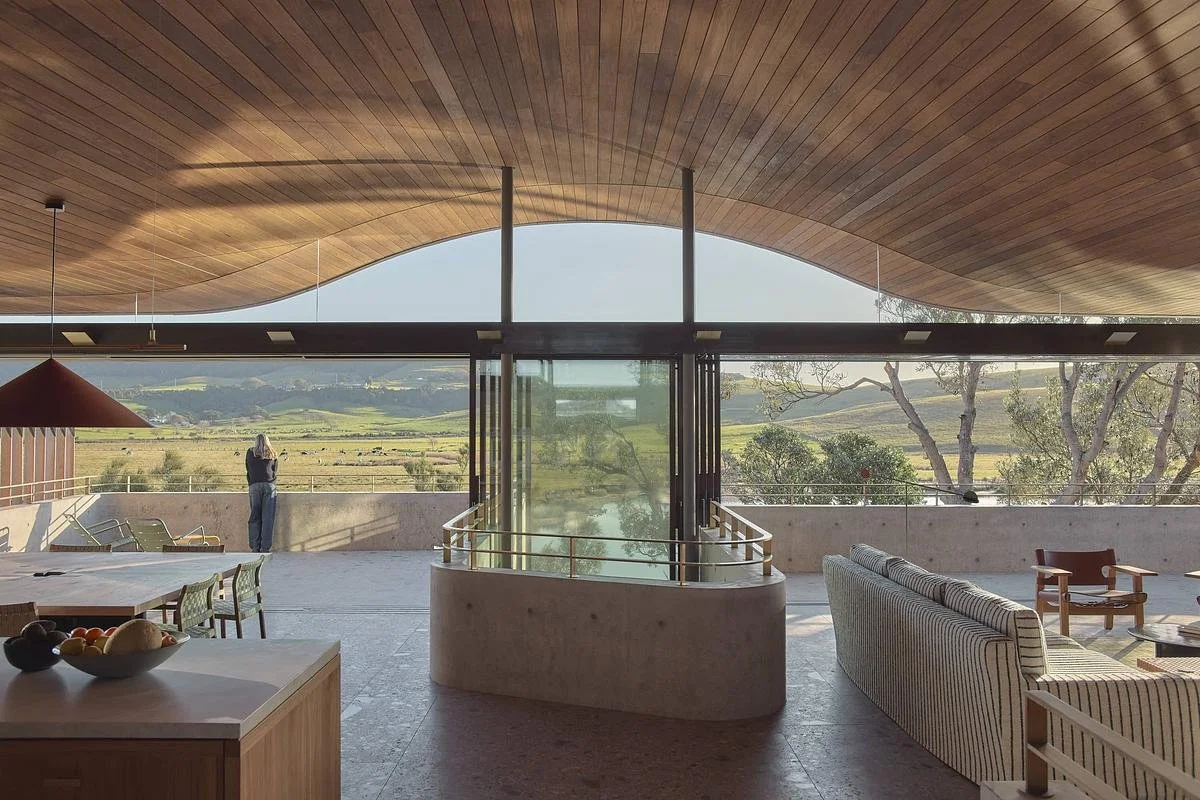
At the heart of the composition sits the off-form concrete light scoop, a sculptural ceiling form that draws daylight deep into the living spaces while framing a view to a Norfolk pine at the front of the property. Its soft arc creates what the architects describe as a "sky-country" outlook, connecting occupants to the seasons, the time of day, and the surrounding tree canopy. The gesture is architectural in its precision and almost meditative in its effect.
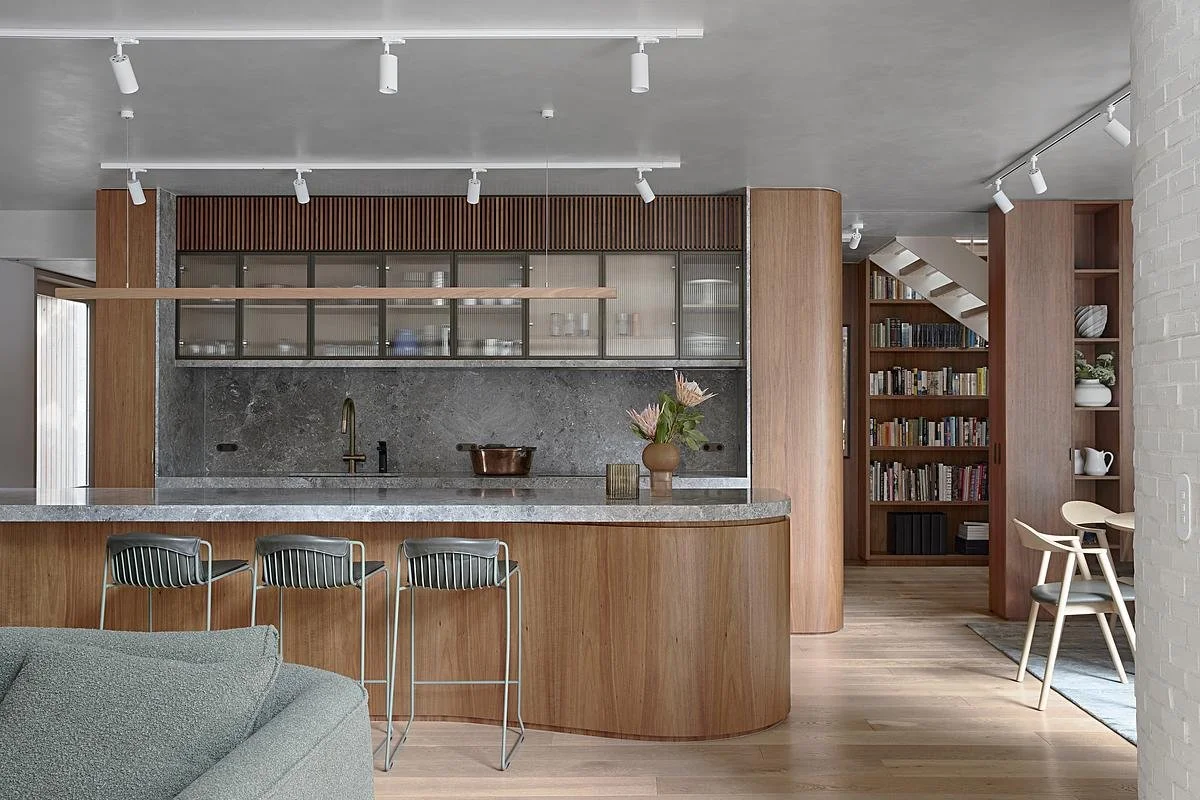
The off-form concrete light scoop arcs across the kitchen ceiling, drawing the sky indoors while the garden beyond completes the threshold the architects set out to dissolve.
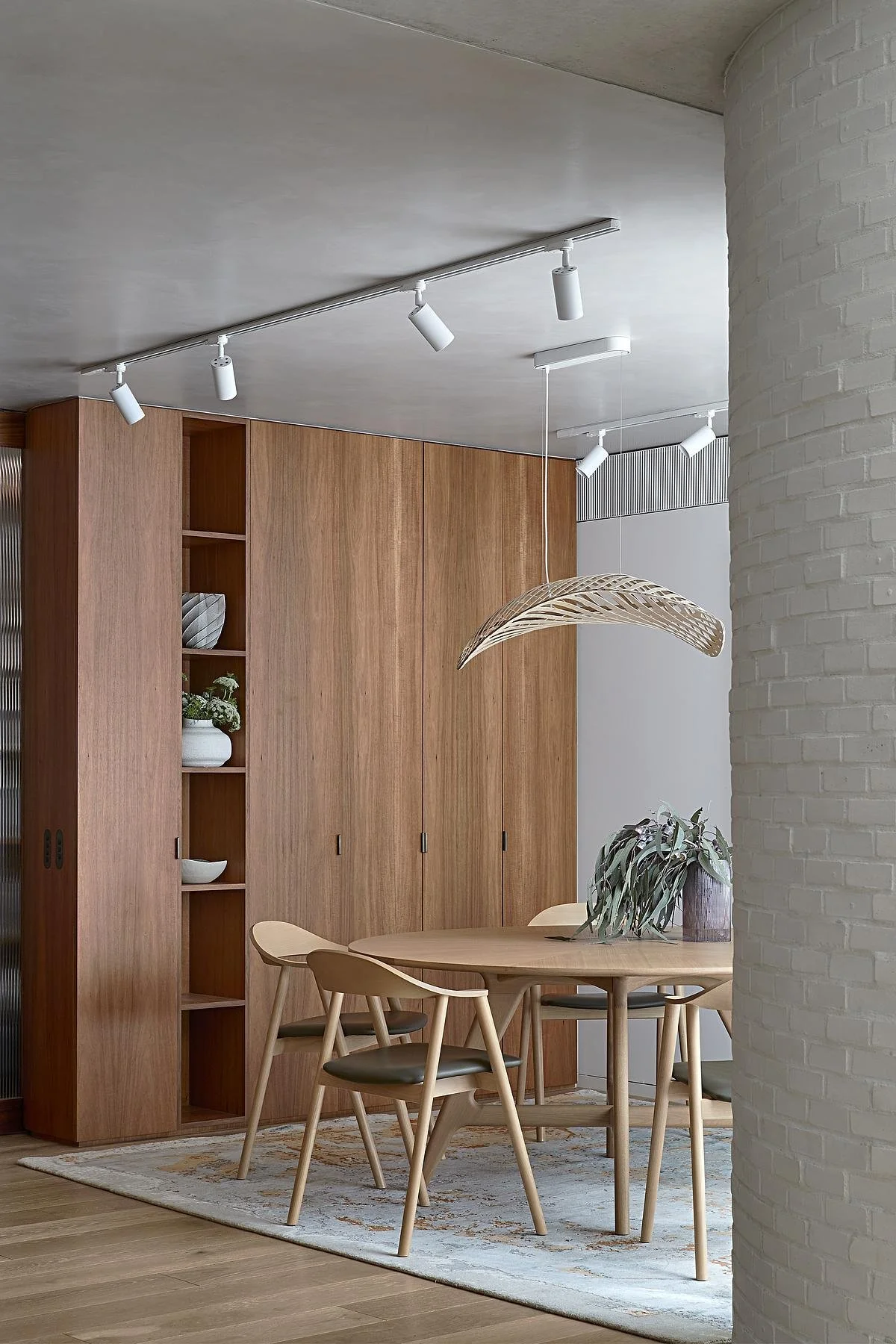
The curved brick wall that moves through the living and dining spaces performs a parallel role. Crafted from pozzolan brickwork with eucalypt-hued cladding, it defines and softens circulation, guiding movement between kitchen, lounge, and garden without the hard grammar of doors or divisions. The wall's warmth stands in deliberate contrast to the cool plaster and Artedomus Fiandre marble surfaces, creating a tactile conversation that extends throughout the house.
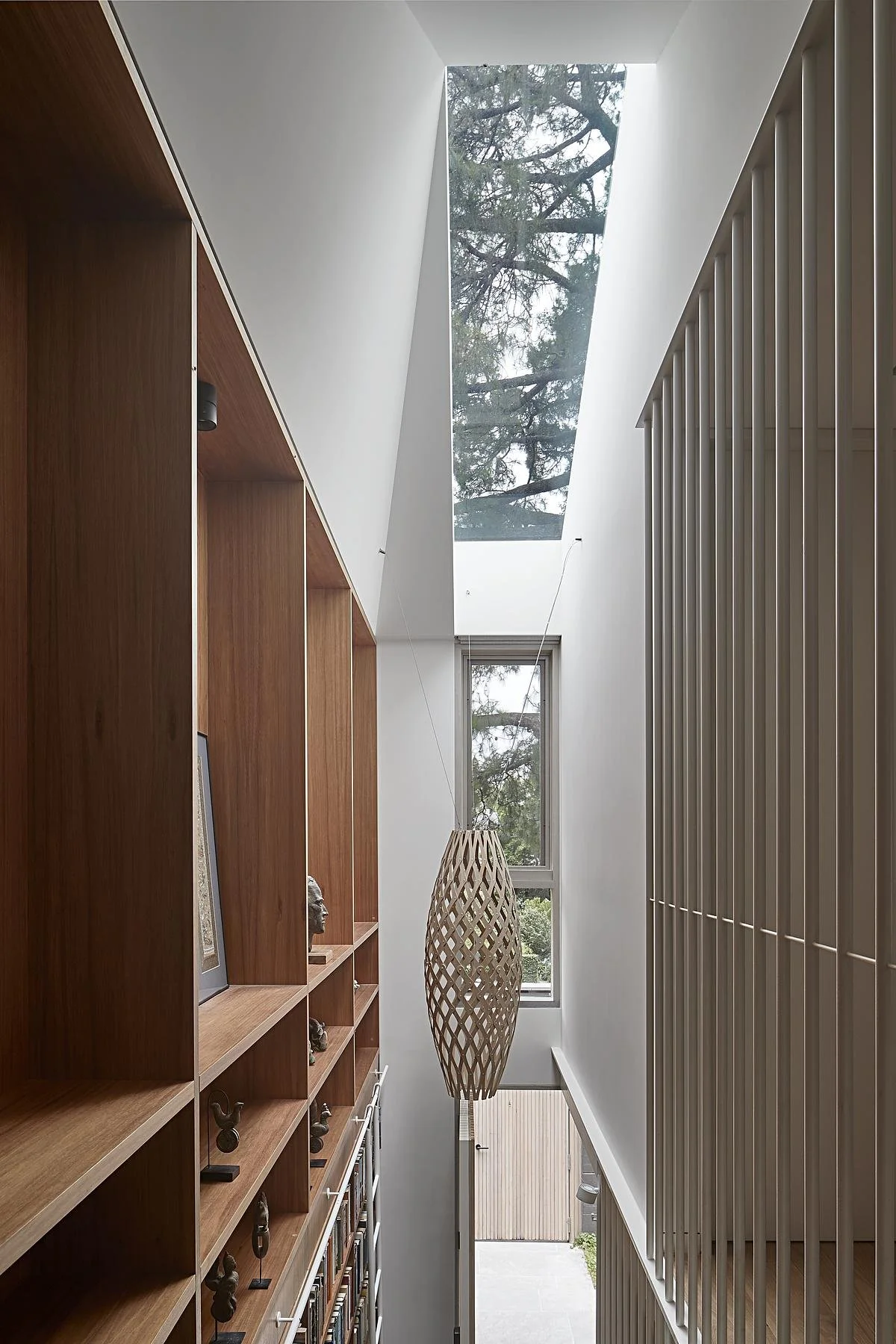
The bookshelf entry is among the project's most personal gestures. Designed specifically to house the clients' large book collection and objects gathered across a life lived overseas, it transforms arrival into something closer to autobiography. Books and artefacts line the walls of the stairwell, framed by an open-tread stair that plays with light and shadow as you move through it. Passing through this space is not incidental; it is a daily act of remembering.
The open-tread stair rises through a floor-to-ceiling bookshelf, transforming vertical circulation into an experiential passage through the owners' collected literary and personal history.
Sustainability is woven into the fabric of the project rather than applied as a layer. Passive solar performance and thermal mass retention reduce reliance on artificial climate control, while FSC-certified Tasmanian blackwood, low-impact Dulux Enviro2 paint, and a meticulous approach to upcycling demolition materials minimize embodied carbon. Bricks were repurposed; windows and doors were redirected to secondary markets. The design's 'less-build' ethic is not a constraint but a conviction.
Recycled timber, pozzolan brickwork, and a cottage garden frame the courtyard terrace, where the boundary between architecture and landscape quietly disappears.
Handmade Perini Marbella tiles in layered forest greens wrap the ensuite walls, paired with a timber floating vanity and brass tapware that bring warmth and craft to every detail.
The home is also planned for ageing-in-place, with level thresholds, generous circulation, and provisions for future handrails and a stair climber, ensuring the house can adapt as its owners do. It is a rare project that thinks about both the past and the future with equal care.
Allegato is ultimately an argument that the most culturally resonant architecture is not always the most declarative. Here, stillness is the statement.
A portrait painting and antique chair occupy the timber-lined stair hall, where the owners' collected objects and inherited pieces give the house its most personal register.
Project Details
Project name: Allegato
Location: Toorak, Melbourne
Architects: Robin Bliem & Associates; Grounded Gardens
Photographers: Shannon McGrath; McMahon and Nerlich
Project size: 198 m²
Site size: 324 m²
Completion date: 2024
Building levels: 2