HOŘEC CENTRE || How a Former Mountain Hotel Became the Living Room of a Czech Village
In a mountain village where winters are long and neighbours matter, the most important building is often the one where people naturally gather.
At the heart of Horní Malá Úpa, a small settlement scattered along the ridges of the Krkonoše Mountains, Hořec Centre has quietly assumed that role. Once a modest hotel built in 1928, the building has been transformed into a multifunctional community centre that reflects the rhythms of local life rather than the fleeting pace of seasonal tourism. Designed by Prague-based studio ADR in close collaboration with the local SKiMU ski resort team, the project reimagines what a mountain building can be when community comes first.
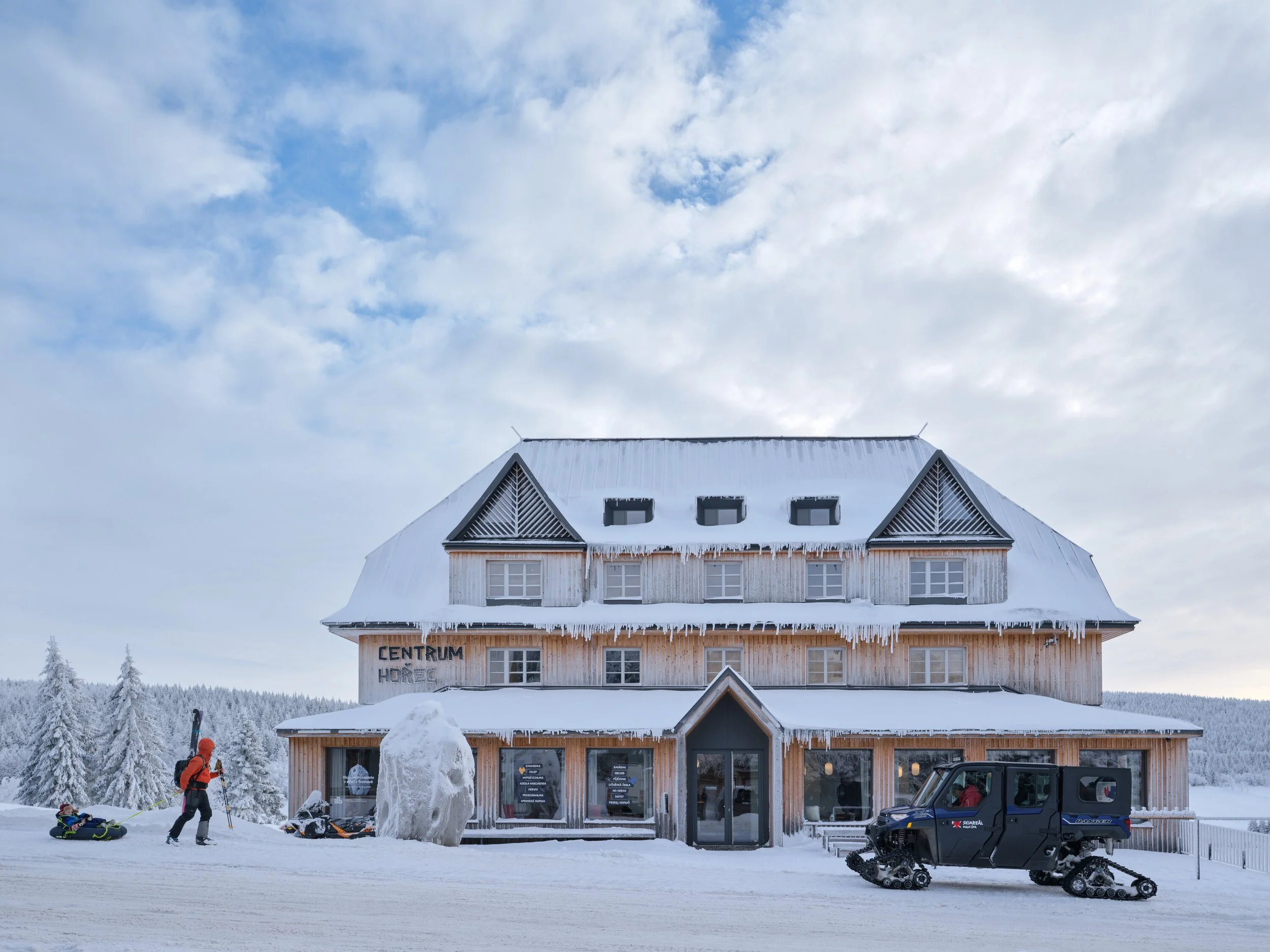
The former Hořec Hotel reemerges as a community centre, its untreated larch façade responding quietly to the alpine landscape and heavy winter conditions.
Rather than treating the former hotel as a relic or a nostalgic monument, the architects approached it as living infrastructure. The goal was not simply to preserve a familiar silhouette, but to give the building a renewed purpose that would serve residents throughout the year. Today, Hořec Centre brings together a café, sports equipment rental, shop, cinema hall, exhibition spaces, and apartments under one roof, creating a place where daily routines and cultural life intersect naturally.
Communal tables, softened by timber walls and filtered daylight, create a relaxed setting for conversation, reading, and everyday pauses between life in the mountains.
The transformation required a fundamental rethink of the interior. The original hotel layout, composed of small enclosed rooms, no longer aligned with contemporary needs or the building’s new social role. ADR opened up the interior across all levels, introducing fluid, generous spaces that encourage movement, visibility, and informal encounters. What was once a place for short stays has become a destination for lingering, conversation, and shared experience.
Open, light filled interiors replace the hotel’s former cellular layout, creating a welcoming space for daily gatherings and informal encounters.
An open landing connects the shop, café, and circulation routes, where suspended lighting sit above exposed brick that quietly references the building’s layered past.
Midway through the renovation, the project took an unexpected turn. As layers of later additions were removed, the architects discovered extensive log structures on the second and third floors, hidden beneath decades of cladding. Such large-scale timber construction is rare in the Krkonoše region, and the finding shifted the tone of the entire project. Rather than concealing the discovery, ADR chose to reveal it, allowing the building’s material history to become part of its present life.
These exposed log structures now define the upper levels, where exhibition spaces highlight both architectural craftsmanship and local culture. In the attic apartments, original timber roof trusses remain visible, lending warmth and authenticity to otherwise restrained interiors. On the lower floors, historic masonry and brickwork sit alongside new concrete extensions, creating a clear yet respectful dialogue between old and new.
Exposed timber roof trusses lend warmth and character to the attic apartments, blending historic structure with contemporary restraint.
Hidden log construction uncovered during renovation now defines the upper floors, turning architectural discovery into a central design feature.
The building’s harsh alpine setting also shaped its design. Positioned on a sloping site and exposed to heavy snowfall, Hořec Centre incorporates concrete extensions that serve both functional and protective roles. These additions shelter entrances from sliding snow while expanding interior capacity, ensuring the building remains accessible and welcoming even in the depths of winter.
Material choices reinforce this balance between tradition and contemporary clarity. The untreated larch façade references local vernacular architecture and has been sourced primarily from regional suppliers. Over time, the wood will weather and darken, allowing the building to blend more deeply into its surroundings. Inside, the palette remains restrained, with timber, concrete, and carefully selected furnishings that support rather than compete with the architecture.
Translucent panels layered with alpine imagery create an atmospheric exhibition space.
Beyond its walls, Hořec Centre extends its influence into the village through a newly created public forecourt. This modest yet meaningful outdoor space provides seating and room for informal gatherings, further strengthening the building’s role as a social anchor. In a place primarily shaped by tourism, the centre offers something quieter and more enduring: a sense of continuity, belonging, and shared ownership.
Hořec Centre is not a dramatic reinvention, nor does it rely on spectacle. Its success lies in its attentiveness to place, history, and the people who use it daily. By listening closely to both the building and its community, ADR has transformed a former mountain hotel into something far more valuable: a living room for the village, built to last.
A compact cinema adds cultural programming to the building’s everyday functions, reinforcing its role as a year round social hub.
PROJECT DETAILS
Studio: ADR
Author: Aleš Lapka, Petr Kolář
Studio address: Libínská 3127/1, 150 00 Prague, Czech Republic
Co-author: Pavel Čermák
Design team: Lucia Honc, Tereza Valošková
Project location: Horní Malá Úpa 112
Project country: Czech Republic
Project year: 2019-2024
Completion year: 2025
Built-up area: 482 m²
Gross floor area: 1674 m²
Usable floor area: 1288 m²
Plot size: 1357 m²
Client: SKiMU
Photographer: BoysPlayNice
Collaborators and suppliers
Statics: Hynek Stiehl
Audiovisual concept, cinema and AV technology supplier: AV MEDIA
Graphic design, logo: Dynamo Design
Construction company: 3K stavby
Custom furniture: Truhlářství Kelner
Locksmith elements: Kovářství Postrach
Photographs of skiers: Herbert Slavík