DREAMER STONE HOUSE || When Marble Becomes Architecture, Not Display
What if a stone showroom stopped presenting products and began composing experiences?
In Shenzhen’s Vanke Cloud City Design Commune, Dreamer Stone House challenges one of the most entrenched assumptions in commercial interior design: that a material showroom exists primarily to display inventory. Designed by PENG & PARTNERS for natural stone brand DREAMER STONE, the 245 square metre space reframes marble not as a backdrop for transaction, but as the central protagonist of a spatial narrative.
A monumental bronze door introduces the spatial procession, establishing ritual and symmetry from the first threshold.
Rather than arranging slabs along walls, lead designer Wang Peng approached the project as an immersive stone gallery. The difference is structural. A traditional showroom prioritizes product visibility. Dreamer Stone House prioritizes spatial experience. From the moment visitors pass through the monumental bronze entrance, they are drawn into a procession of axial corridors, symmetrical thresholds, and layered chambers that unfold with deliberate rhythm. The sequence is not accidental. It is choreographed.
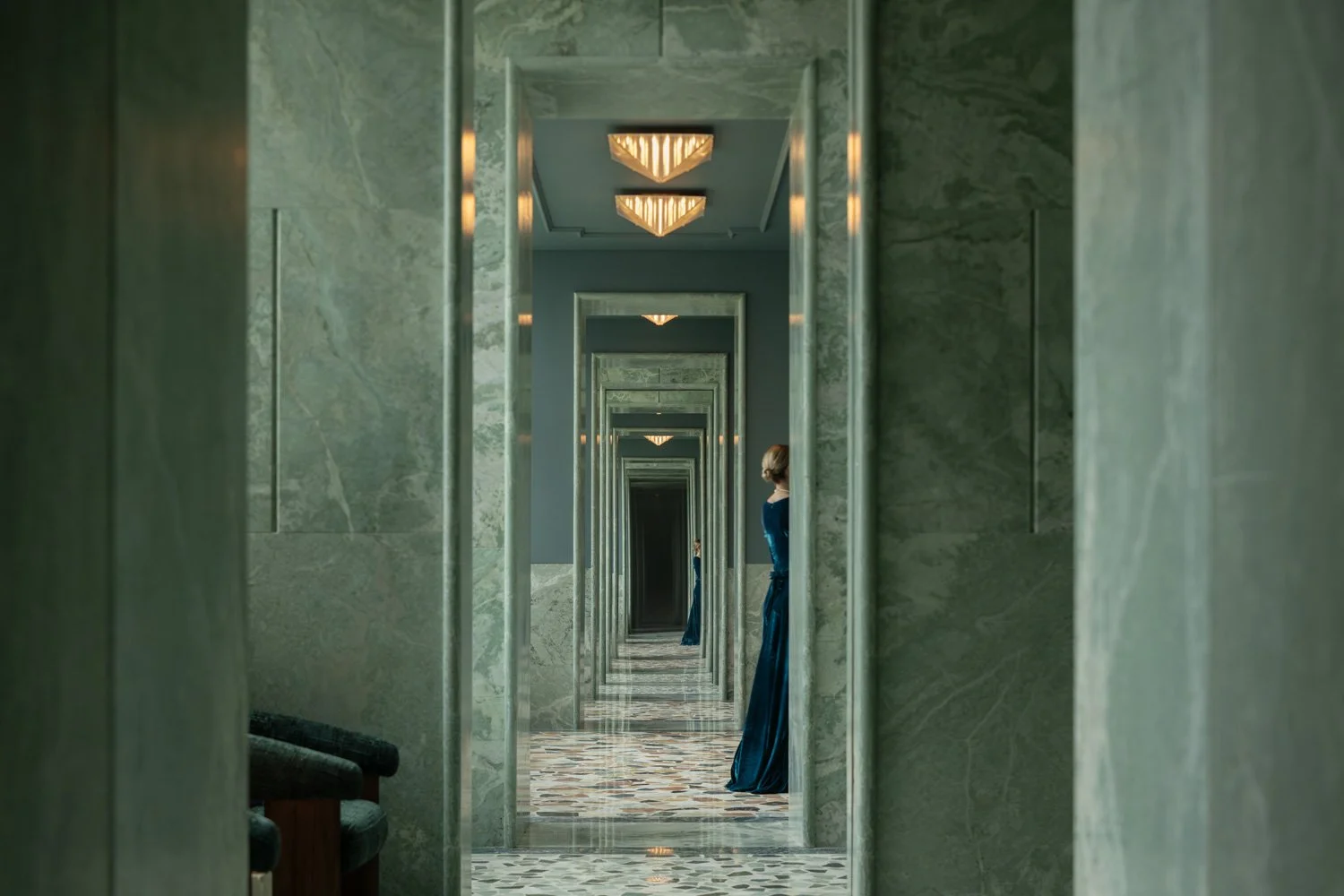
Axial alignment and rhythmic door openings transform circulation into narrative, guiding visitors through layered perspectives.
Symmetry and axial planning form the backbone of the design strategy. Inspired by Milanese rationalism and informed by Gio Ponti’s clarity of order, the layout establishes a sense of ceremony. Doorways align. Sightlines extend. Ceilings articulate geometric progression. The result is spatial compression and release, guiding visitors from the urban exterior into a controlled interior environment where material perception becomes heightened.
This architectural framing is essential to the project’s thesis. Marble is no longer a static surface to be evaluated. It becomes an active medium shaping light, movement, and atmosphere. Green marble appears in both continuous wall panels and fragmented floor inlays, creating a dialogue between cohesion and variation. In the meeting rooms, grey stone reveals dual personalities through polished and split face finishes within the same enclosure, demonstrating how one material can carry both refinement and rawness.
Continuous wall slabs contrast with fragmented floor inlays, demonstrating varied expressions of the same stone.
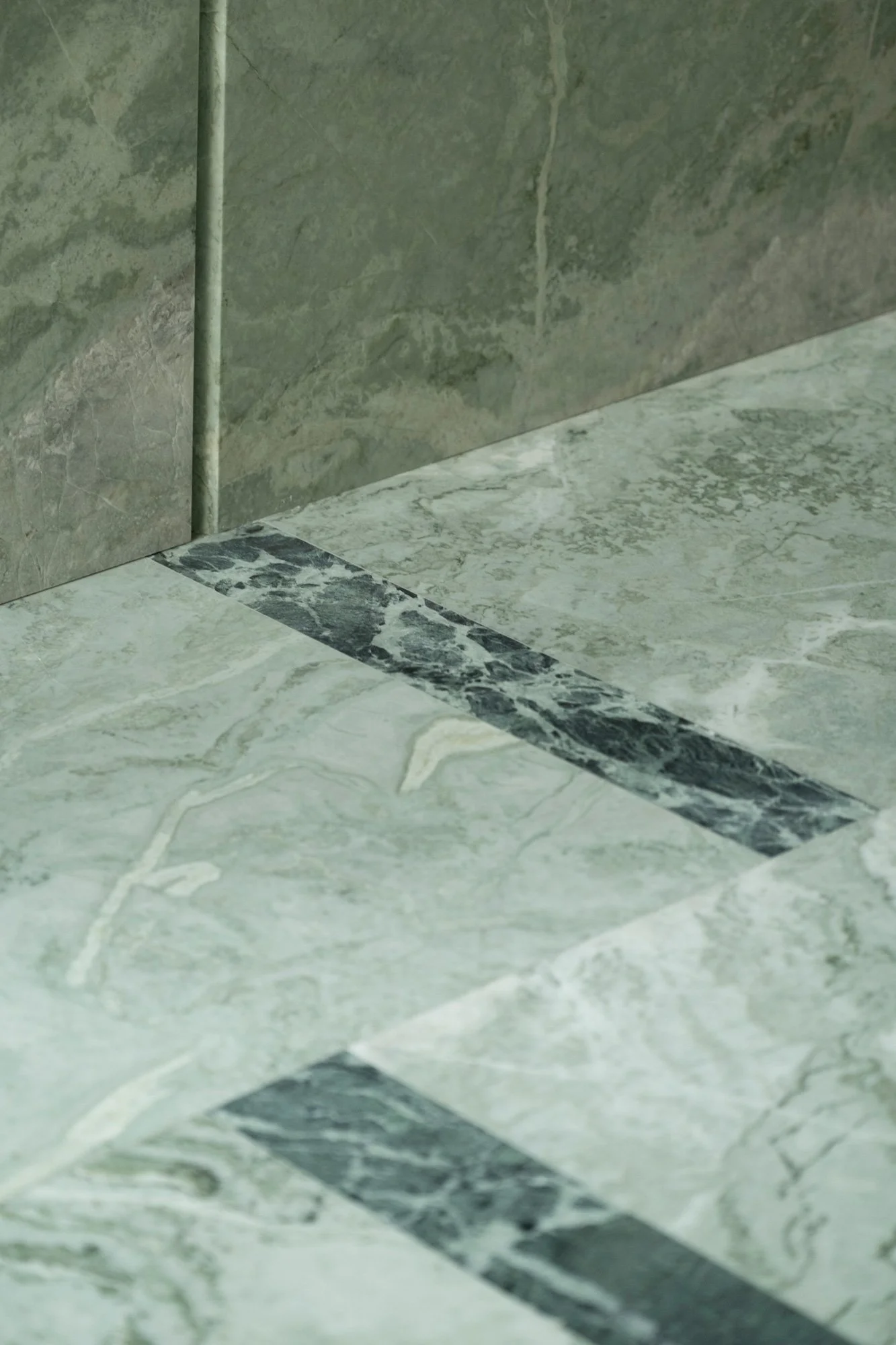
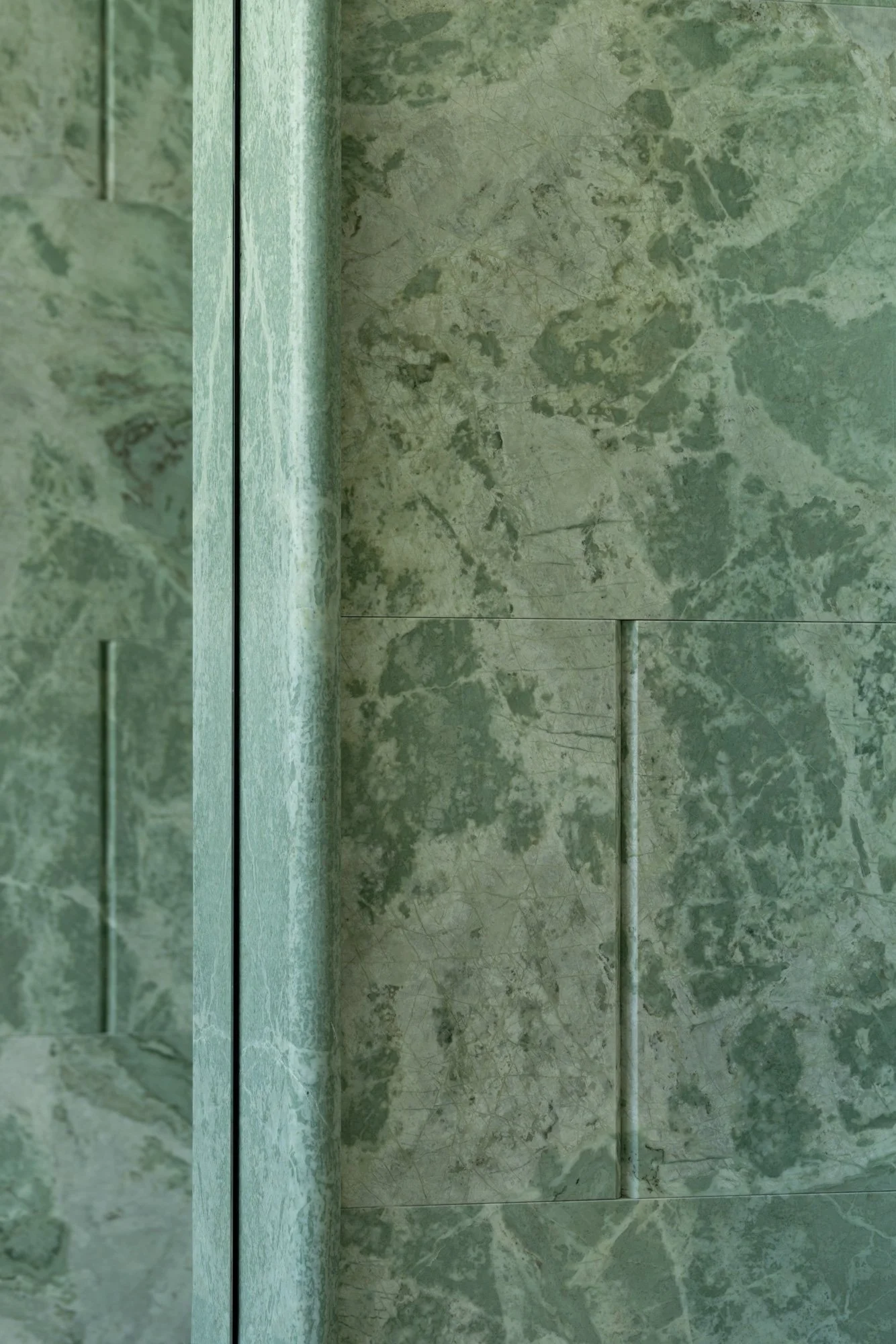
Material curation was treated with curatorial discipline. From DREAMER STONE’s extensive library, stones were selected based on three criteria: alignment with the project’s rational Eastern aesthetic, compatibility with function, and harmony with complementary materials such as bronze, timber veneer, and translucent glass. Highly decorative or overly expressive stones were deliberately excluded. Restraint, not spectacle, defines the palette.
Polished and split face grey stone finishes coexist within one enclosure, revealing dual material character.
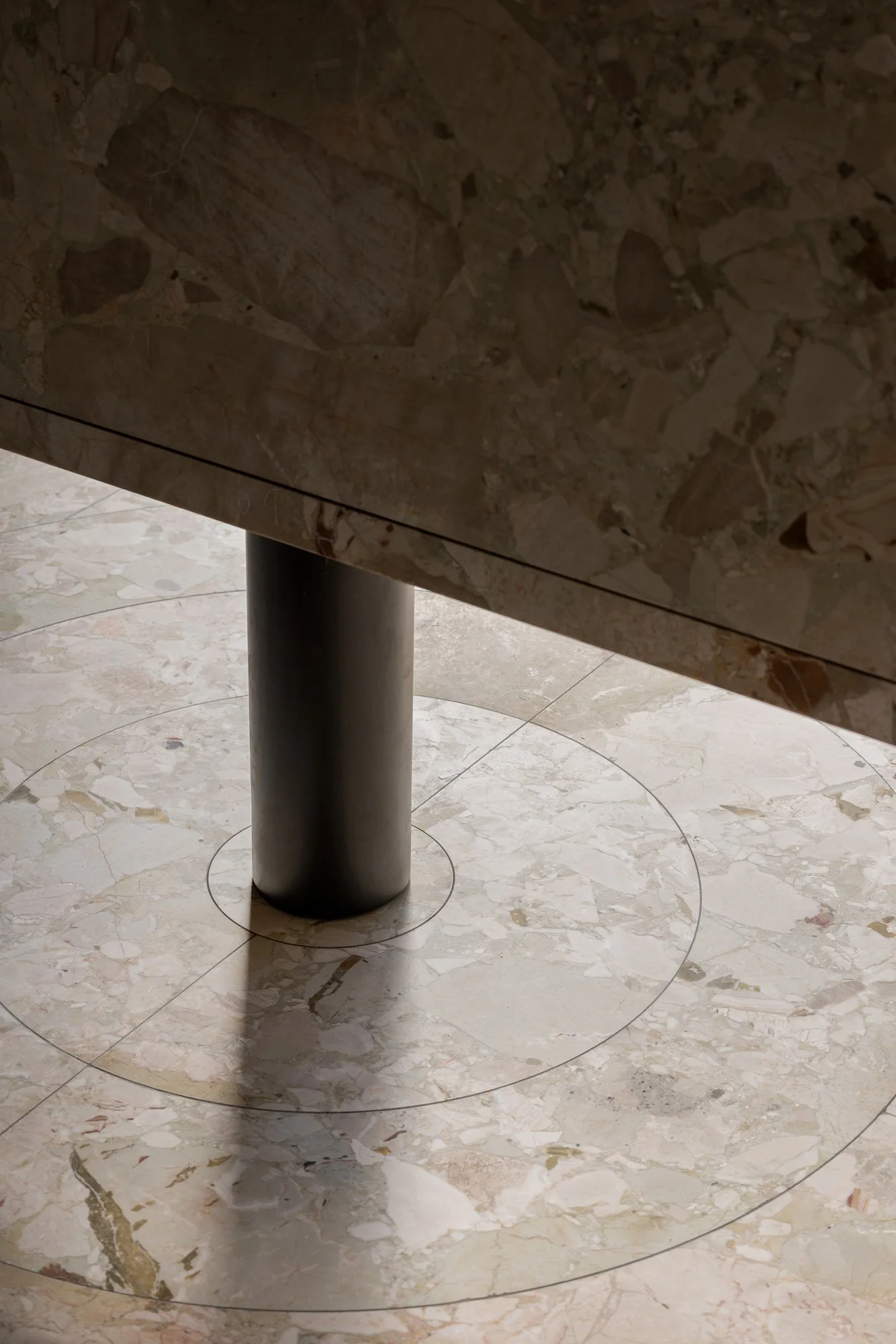
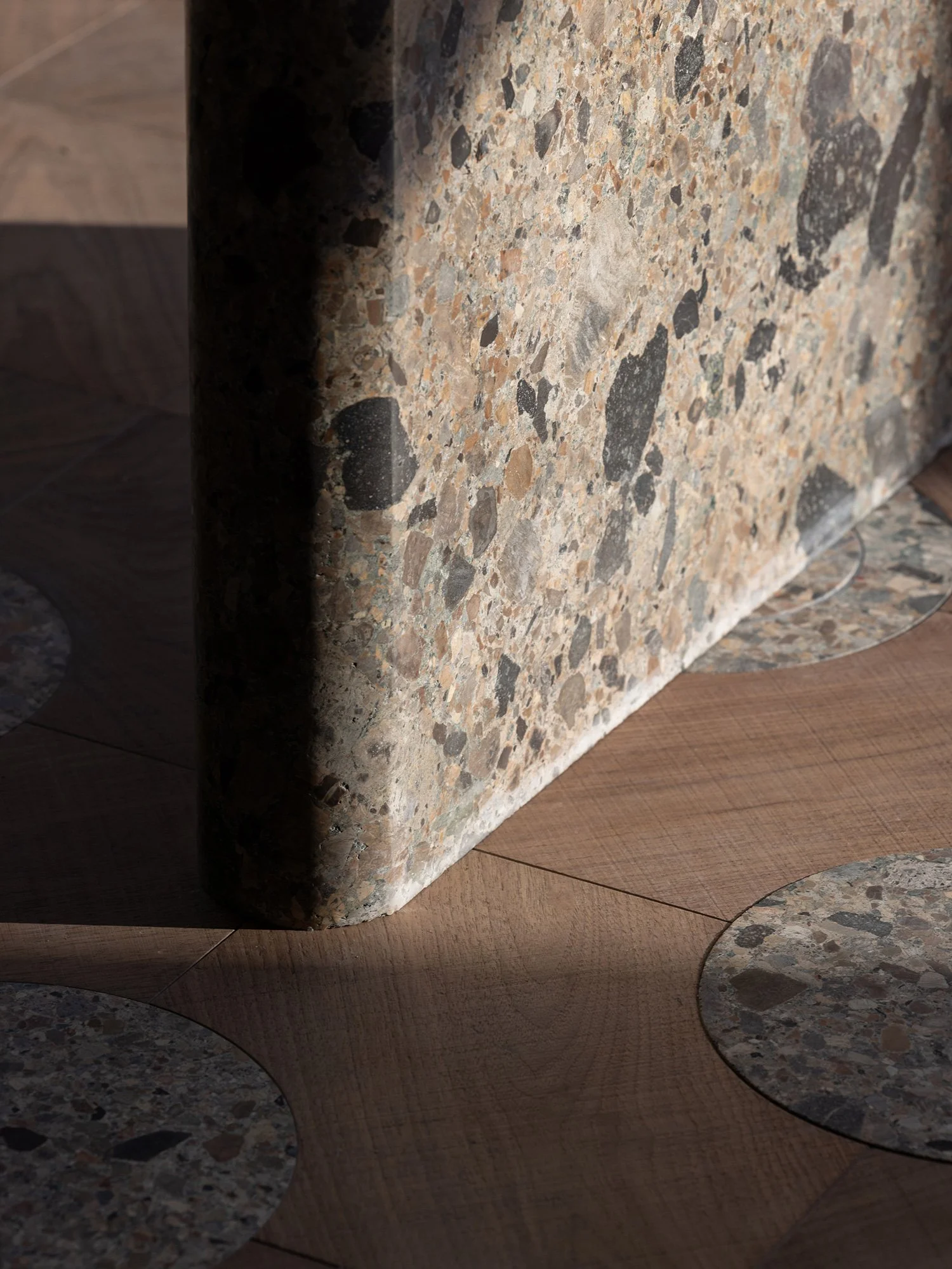
One of the most technically demanding applications appears in the western kitchen island, constructed from Brazilian meteor stone with a natural split face surface. Traditionally, such textures are confined to vertical surfaces due to concerns around structural stability and porosity. Uneven fissures risk stress imbalance, while high absorption rates can lead to staining and efflorescence. Through high precision leveling, comprehensive six sided protective treatment, and calibrated lighting integration, the stone transitions from decorative cladding to functional centrepiece. Craft becomes the bridge between aesthetics and durability.
Light plays a decisive role throughout the gallery. Rather than overwhelming the stone, illumination is used to reduce visual weight and reveal subtle tonal shifts. Translucent glass panels introduce a sense of separation without disconnection, allowing spaces to feel layered yet continuous. This strategy softens marble’s inherent density, transforming it from monumentality into measured elegance.
A natural split face surface engineered for high frequency use challenges conventional limitations of textured marble. Translucent glass panels and controlled illumination reduce visual density, allowing marble’s tonal depth to emerge.
The broader context of the project speaks to a pressing industry question: how does natural marble position itself amid the rise of engineered sintered stone and large format ceramics? Dreamer Stone House suggests that the answer is not competition, but differentiation. While engineered materials excel in uniformity and cost efficiency, natural stone offers geological singularity. Its textures are unrepeatable. Its veining records time. Its value lies in authenticity and spatial depth.
By elevating marble from product to architectural language, PENG & PARTNERS reposition natural stone within contemporary design discourse. The project demonstrates how immersive showroom design can shift brand perception from material supplier to aesthetic authority. Here, the logic is clear. Product becomes space. Space becomes product.
A symmetrical lounge framed in stone and light demonstrates the project’s architectural logic.
Dreamer Stone House ultimately proposes a new standard for material exhibition. It shows how a stone showroom can function as an experiential gallery, where architectural order, disciplined curation, and technical innovation converge. Marble is no longer simply observed. It is inhabited.
Polished marble walls form a tactile backdrop to quiet inhabitation.
PROJECT DETAILS
Project Name: Dreamer Stone House
Location: Zone B, Design Commune, Vanke Cloud City, Shenzhen
Area: 245 square meters
Completion: November 2025
Design Firm: PENG & PARTNERS
Chief Designer: Wang Peng
Project Director: Li Yuan
Art Director: Lyu Qing
Furnishings Consulting: P Projects
Construction: Maili Digital Technology (Hangzhou) Co., Ltd.
Photos: Jack Qin, Zuxi Huang, Si Yu
Video: Chen Qiuquan
Suppliers: MOORGEN, SAVOIA, COSY SPACE COIN, NÍNG, MENGLV, SHANGMEI, V-ZUG, SEGGI, KBH, CETTIGA, SINGCHAN, TABU, ALPI
Video: https://youtu.be/OGanByMDWhk