ABRIGOS DE MONTANHA || When Small Architecture Carries Cultural Weight
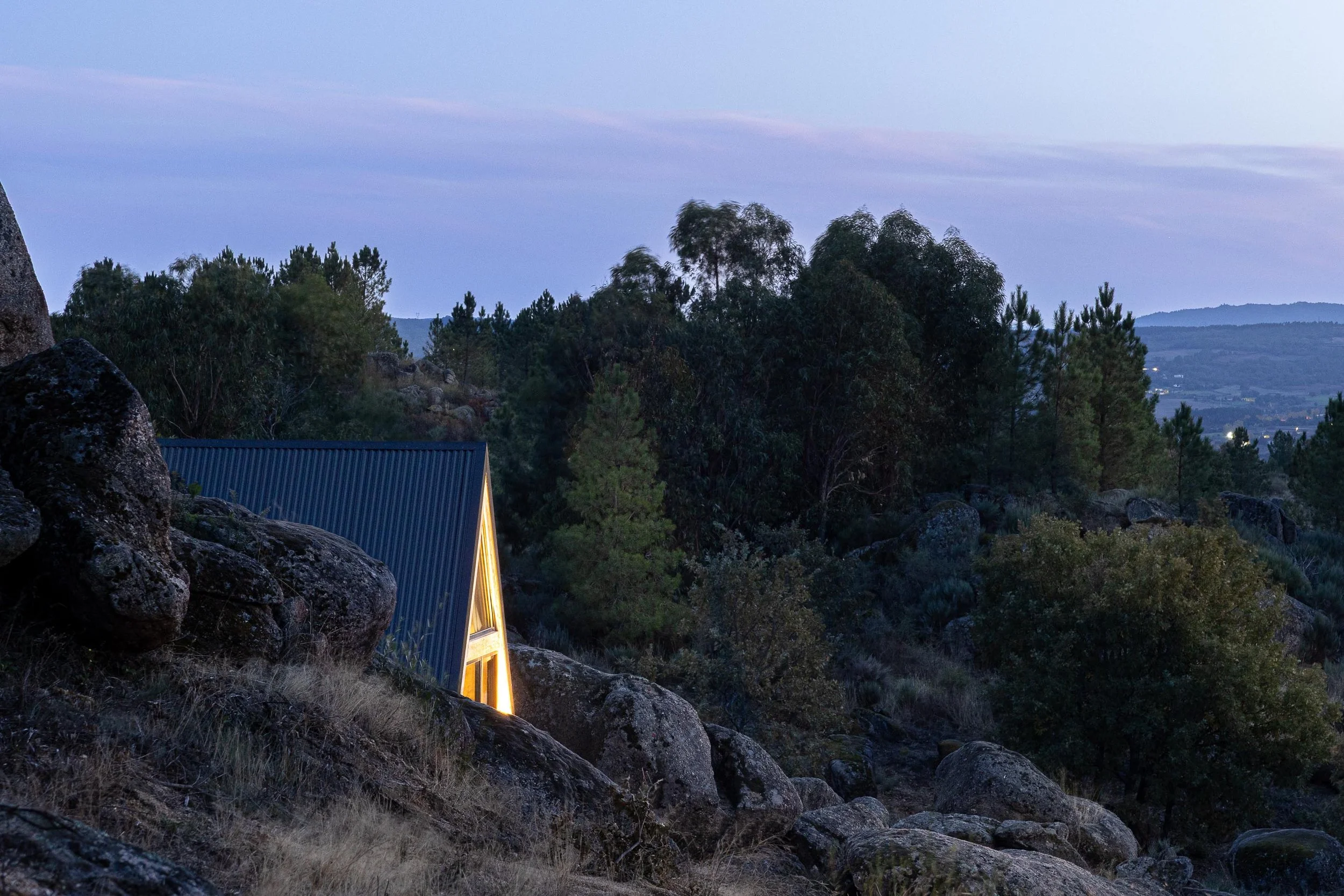
Some architectural ideas are best expressed through reduction, not addition.
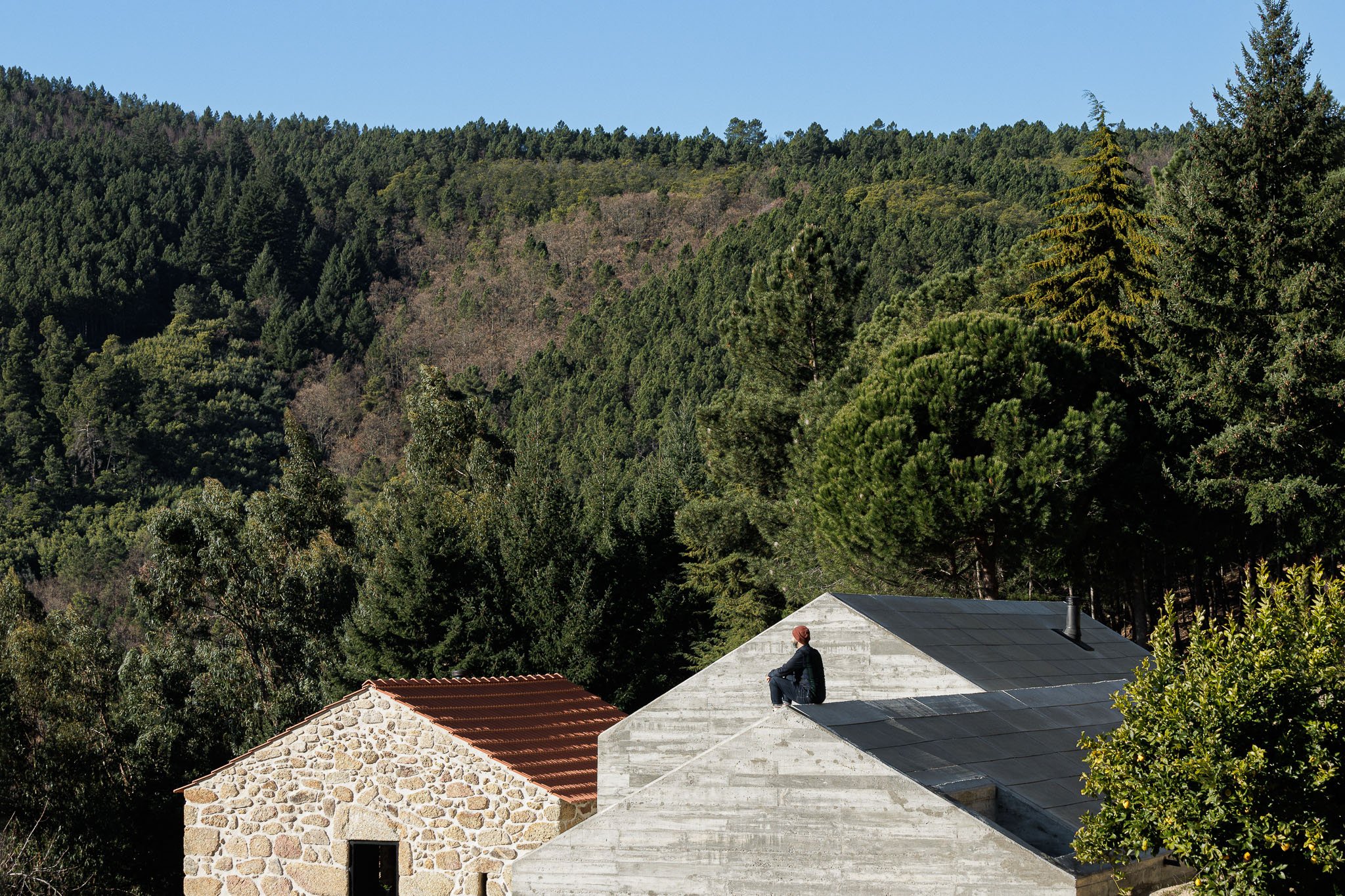
Set within the vast terrain of Portugal’s Serra da Esperança, the Abrigos de Montanha project approaches architecture as an act of refinement rather than assertion. Developed as part of The Vagar Country House in Belmonte, the trio of mountain shelters resists the temptation to perform visually. Instead, they return architecture to one of its most enduring roles: to provide shelter with clarity, restraint, and cultural awareness.
The design draws conceptual, formal, and constructive inspiration from the region’s vernacular shepherd shelters, locally known as Choças. These structures, shaped over generations by necessity rather than style, offer a lineage of architectural intelligence rooted in place. Rather than replicating them literally, the project abstracts their logic into a contemporary form that feels both familiar and resolutely current.
Each shelter is positioned to engage the Serra da Esperança landscape without overwhelming it.
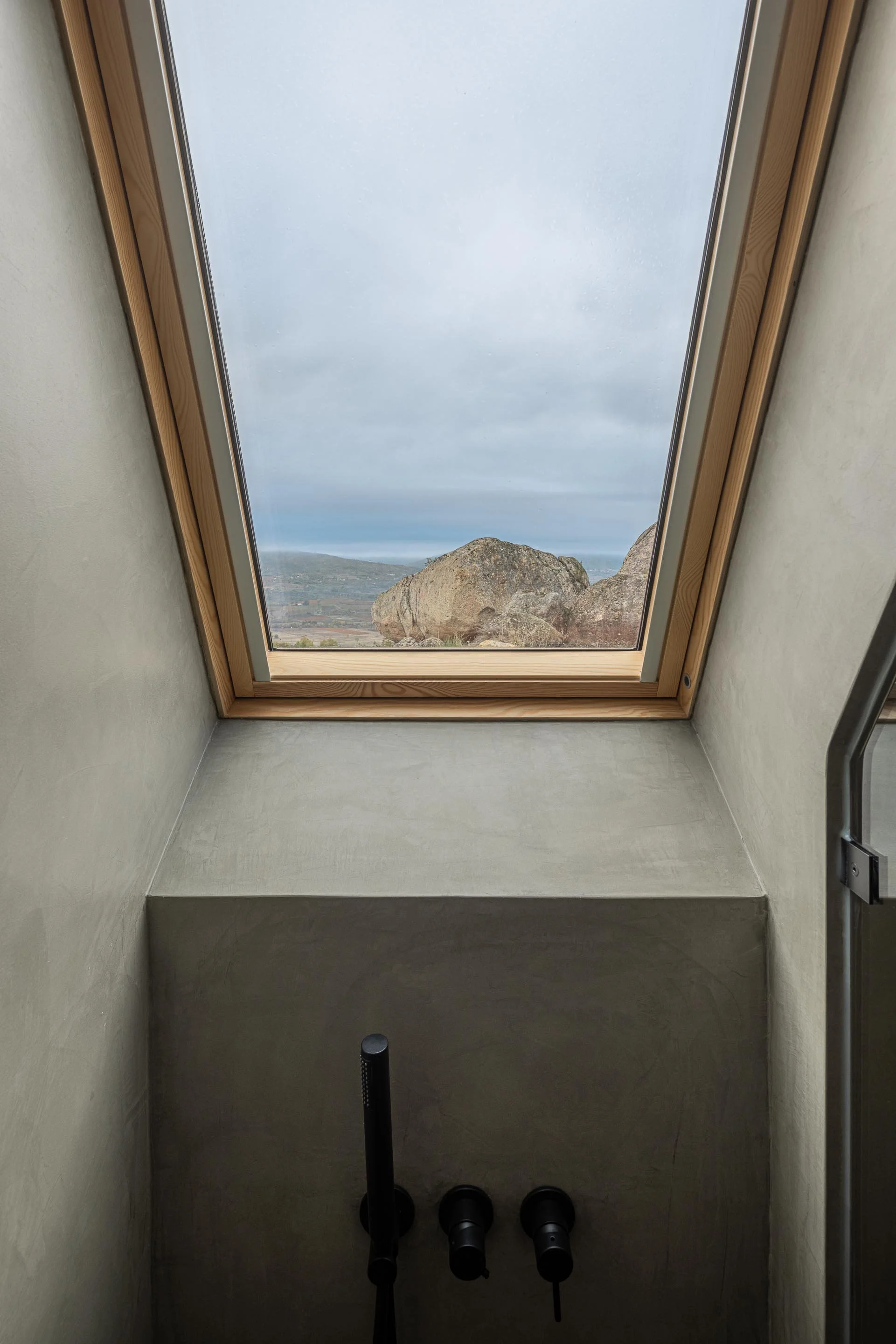
Each shelter is carefully positioned across the mountainous landscape, oriented toward the Cova da Beira valley and offering distant views of Serra da Estrela. The siting respects the natural contours of the land, allowing the buildings to sit quietly within existing vegetation and rocky outcrops. The experience shifts subtly from one shelter to the next, offering varied relationships to light, horizon, and terrain while maintaining a shared architectural language.
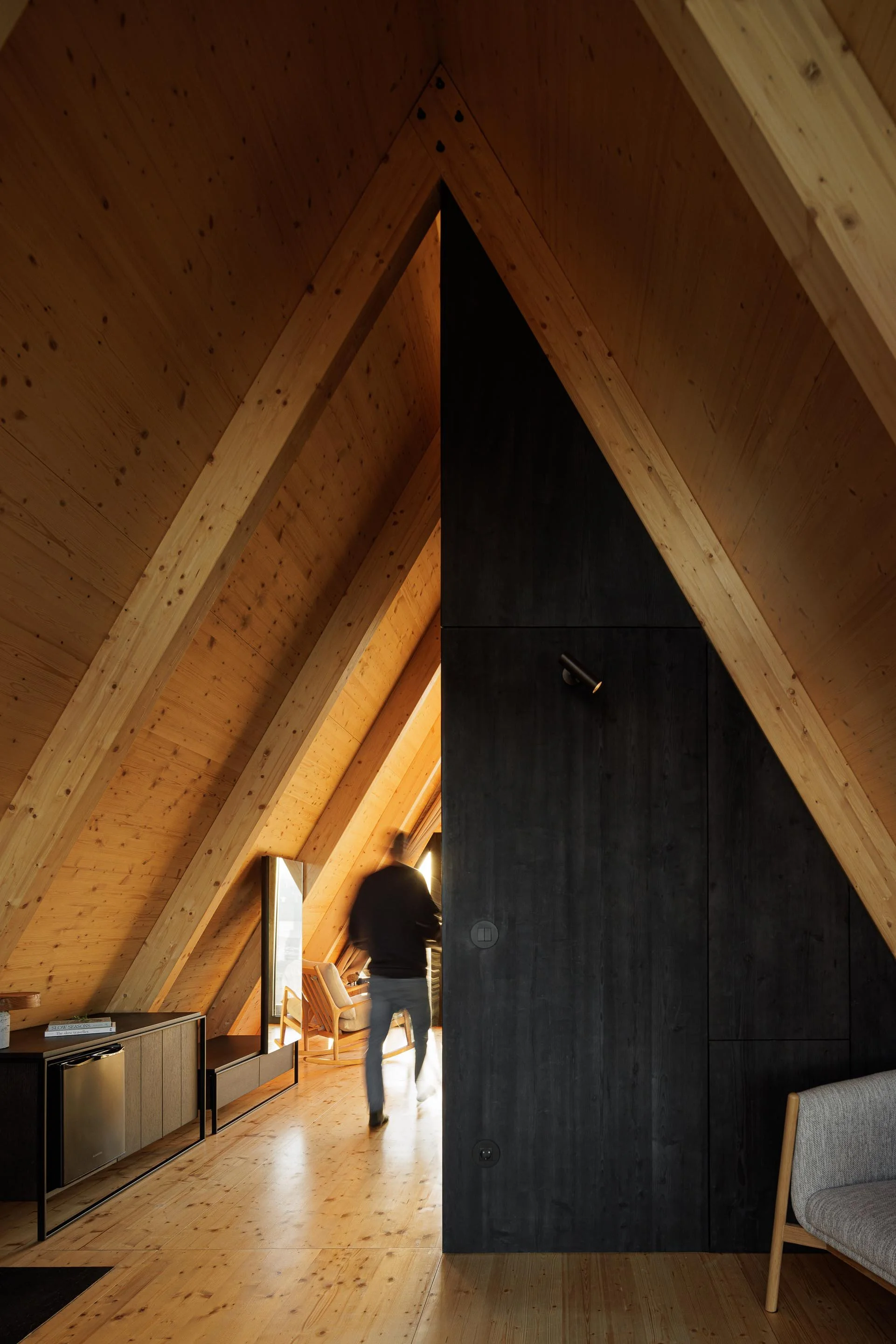
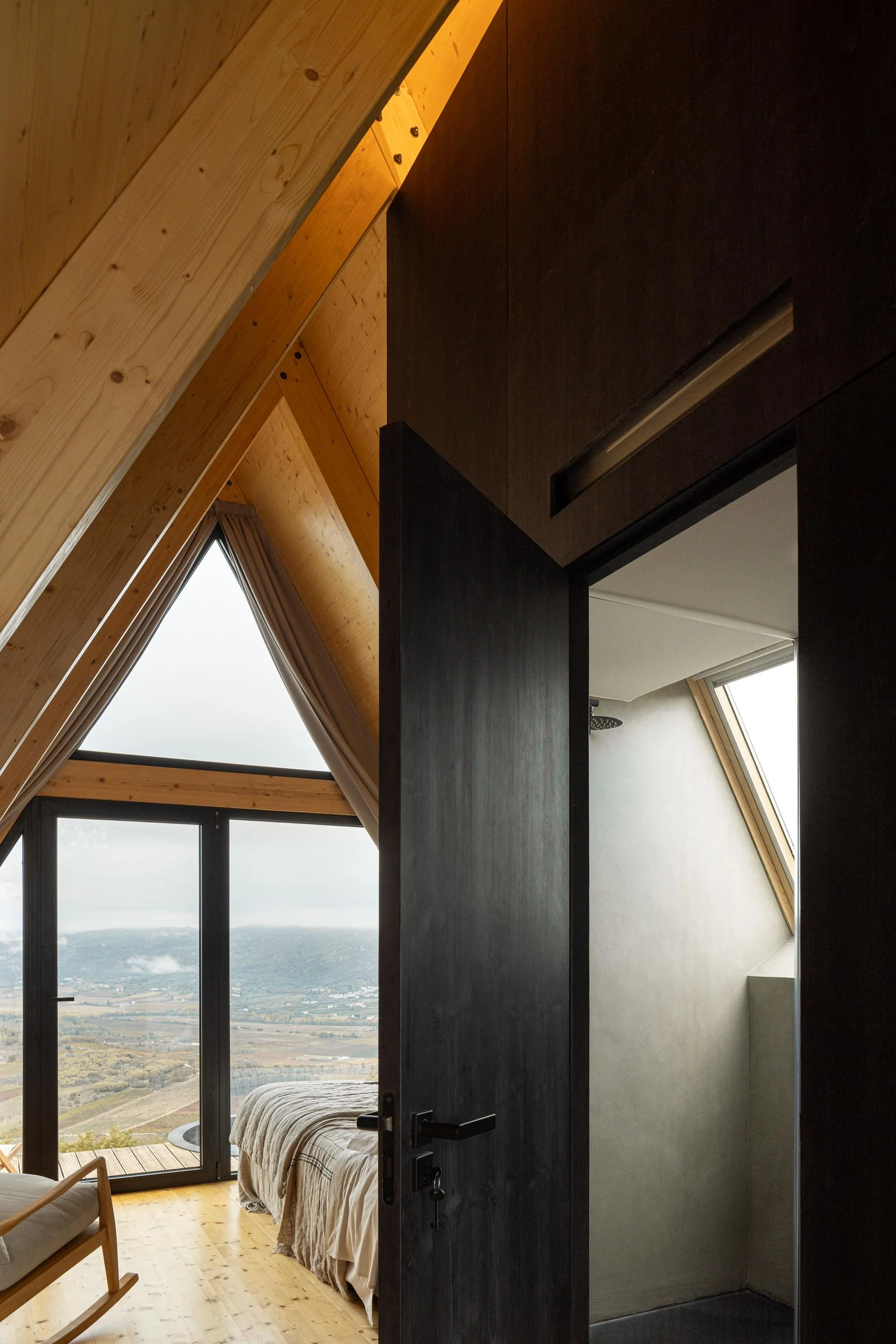
At just 37.5 square metres, the shelters demonstrate how spatial generosity is not dependent on size. Their equilateral triangular prism form creates a compact yet fluid interior, where a central volume containing the bathroom and storage functions as the sole spatial divider. This organizational decision keeps the living and sleeping areas visually connected, reinforcing a sense of openness despite the minimal footprint.
Above: Large glazed openings frame views toward the Cova da Beira valley and Serra da Estrela beyond. Below: Certified wood allows the structure to weather naturally, reinforcing its relationship with place over time.
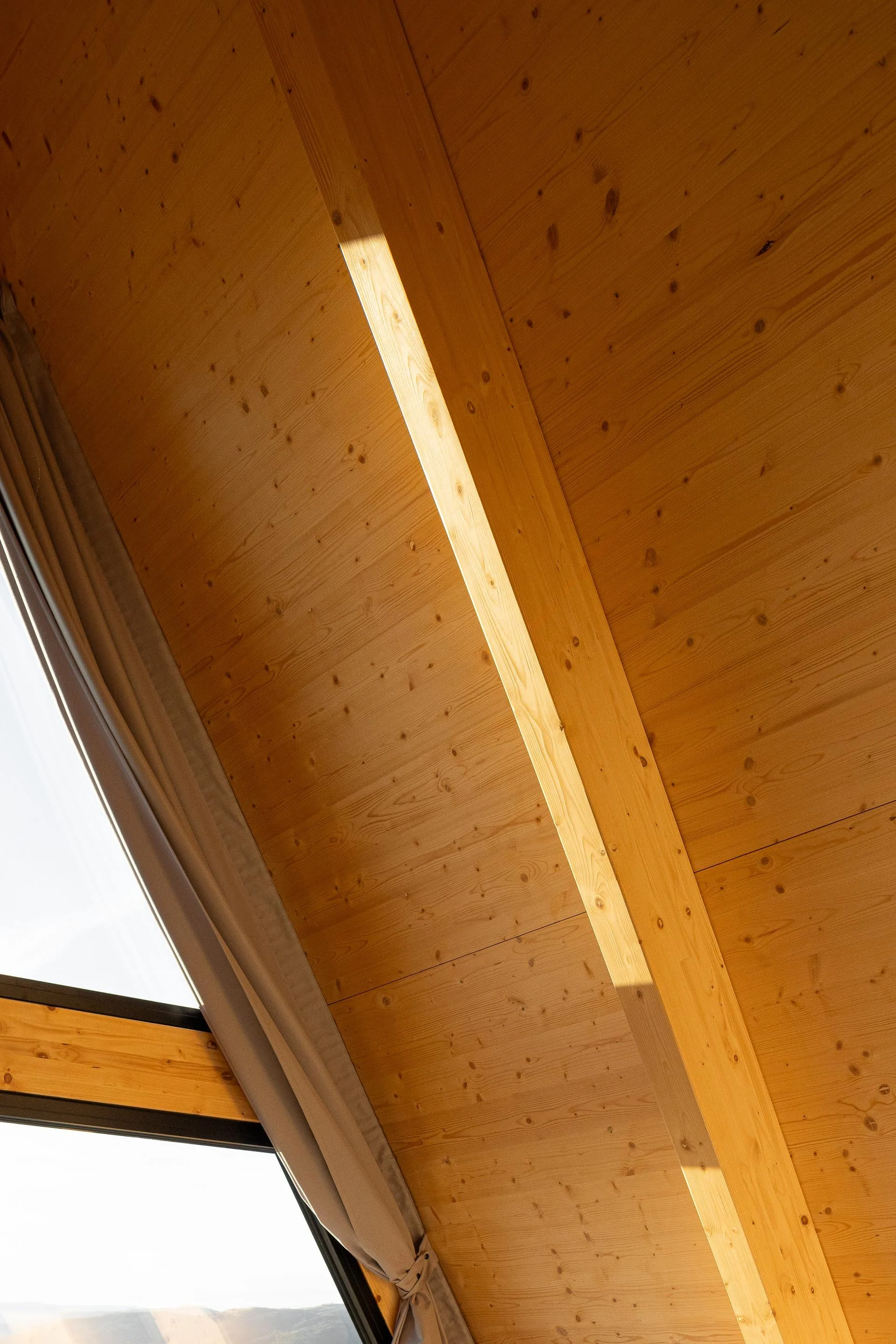
Material choices further reinforce the project’s disciplined approach. Certified wood forms the primary structure, selected not only for its environmental credentials but also for its capacity to age with dignity. As the material weathers, it deepens the shelters’ relationship with their surroundings rather than detracting from it. Large glazed openings introduce abundant natural light, dissolving the boundary between interior and exterior and anchoring daily life to the rhythms of the landscape.
The modular construction of the shelters allows each unit to operate independently as a workspace or guest refuge, while remaining part of a broader architectural system. This adaptability reflects a contemporary understanding of remote living, where flexibility and autonomy are increasingly valued. More importantly, it underscores the idea that architecture can be both repeatable and site responsive without becoming generic.
Above: The central bathroom and storage core subtly organizes the compact interior plan. Below: Interior spaces remain visually continuous, enhancing spatial clarity within a minimal footprint.
More than an aesthetic layer, sustainability here is a foundational principle. From simplified assembly to minimal site disruption, the project frames architecture as a tool for stewardship rather than consumption. By prioritizing conservation of the existing landscape, the shelters propose a model for building in sensitive environments that is deliberate, measured, and respectful.
Abrigos de Montanha ultimately succeeds not by redefining what a mountain shelter looks like, but by reconsidering what it should do. It is an architecture of judgement rather than gesture, where every decision carries weight precisely because there are so few of them. In reducing architecture to its essentials, the project reminds us that cultural significance often emerges not from excess, but from clarity of intent.
Architecture recedes, allowing the surrounding terrain to define the experience.
PROJECT DETAILS
Project name: Abrigos de Montanha - Mountain Shelters
Architecture Office: Filipe Pina Arquitectura
Main Architect: Filipe Pina
Collaboration: Diana Cruz, David Bilo, André Teixeira
Instagram: fp_architectures
Client: The Vagar – Country House
Location: Serra da Esperança, Belmonte
Completion: 2025
Total area (m2): 37,50m2
Builder: Loopa Gestão de Obra
Inspection: Filipe Pina
Engineering: Ricardo Pereira
Decoration: Lígia Casanova
Architectural photographer: Ivo Tavares Studio | Instagram