PINGMENLI PRIVATE RESIDENCE || Where Suzhou Garden Craft and Italian Minimalism Find a Common Language
Two of the world's most quietly confident design traditions walked into a courtyard in Suzhou. Neither blinked first.
The result is Pingmenli Private Residence, a 1,000-square-metre home near Suzhou's historic Taohuawu district, designed by Zhang Haihua of Z+H Renhai Design for a three-generation family. Set within a 700-square-metre courtyard, the project poses a question that most designers would avoid entirely: what happens when Suzhou garden philosophy and Italian minimalism are asked not to coexist politely, but to genuinely collaborate?
The answer, it turns out, is something neither tradition could have produced alone.
Floor-to-ceiling glazing frames the intricately carved timber facade of the courtyard pavilion, placing classical Suzhou garden architecture in direct dialogue with the home's contemporary minimalist interior.
The collaboration begins outside, where Master Yuan, a garden craftsman in his sixties, composes the courtyard rockery by reading the inherent grain of each stone. No blueprint governs his placement; geology does. Every angle is calibrated to echo natural mountain formations, drawing on a craft lineage that stretches back centuries. Inside, Italian craftsmen flew to Suzhou to complete the installation of bespoke cabinetry to millimetre-level precision, flush-mounting wardrobe systems within walls so cleanly that storage becomes indistinguishable from architecture. Two disciplines, two continents, one shared commitment to getting it exactly right.
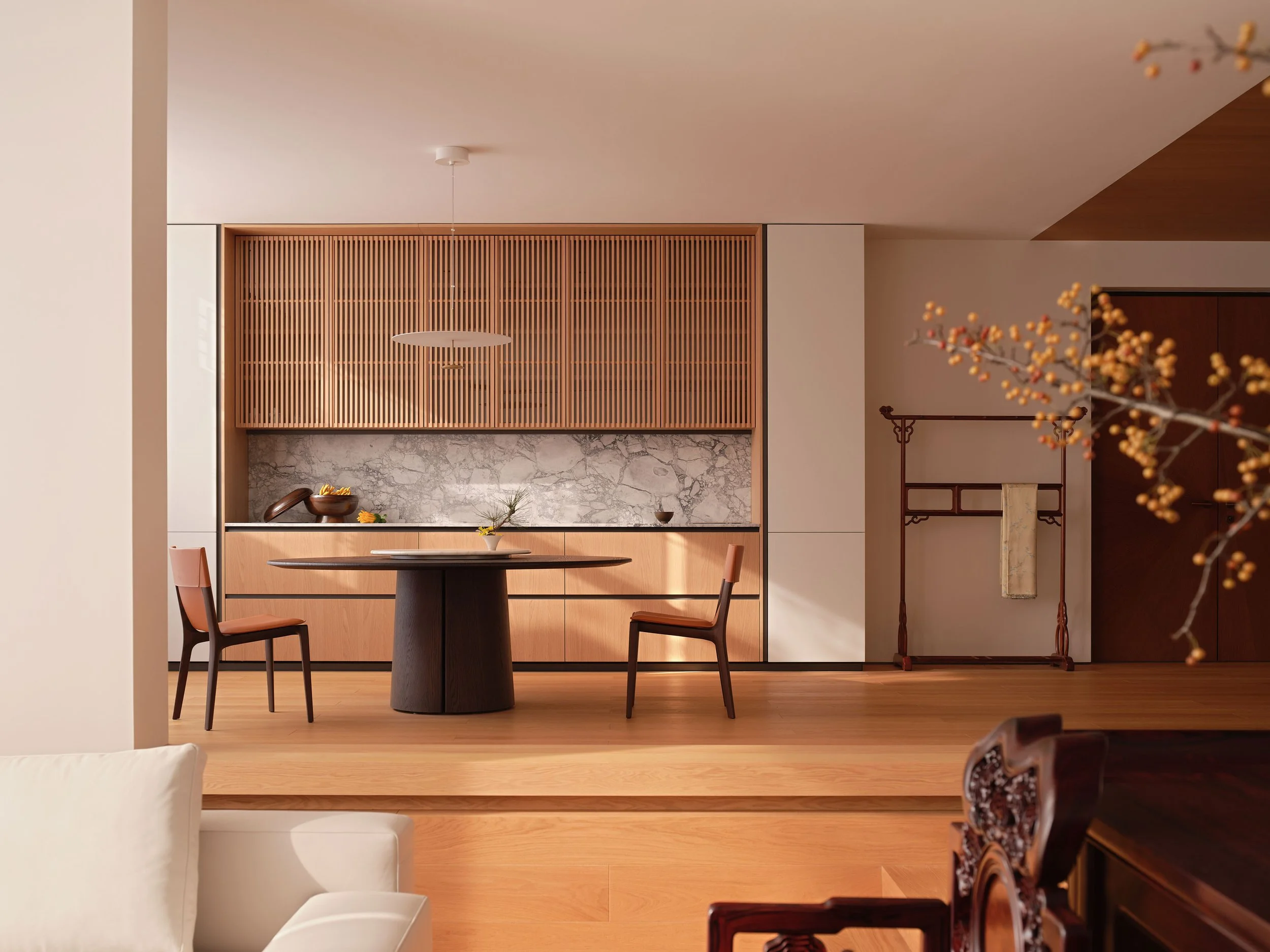
A cylindrical dark-stained dining table anchors the raised dining platform, where slatted timber cabinetry, a veined marble backsplash, and a branch of autumn berries compose a scene that is equal parts Italian precision and Jiangnan poetry.
Zhang Haihua frames this dual sensibility through a concept he calls Eastern Minimalist Humanism, a design approach rooted in the restrained spatial logic of Jiangnan aesthetics and the clean material language of Italian design. Sheer curtains filter light like semi-translucent xuan paper, casting ink-like shadows across white walls. A concealed visual axis runs from the courtyard rockery through the living room colonnade to the ascending staircase, reflecting the organizational logic of classical Jiangnan mansions. The home breathes through this sequence; each room is less a destination than a pause within a longer, considered journey.
A Ming-style console and Molteni&C furnishings share the sunken living room, where warm timber tones and sheer curtains filter courtyard light into shifting ink-like shadows.
The furniture carries the same dual fluency. A Molteni&C sofa faces a Ming-style console in the sunken living room, the pairing neither ironic nor decorative but genuinely conversational. Molteni&C cabinetry anchors the dining area alongside a round table that balances elegance with daily function. A rare Song-dynasty ceramic piece sits in a floating cabinet adjacent to a minimalist coffee table. These are not styling decisions; they are arguments about what contemporary Chinese luxury might actually mean when it stops performing and starts living.
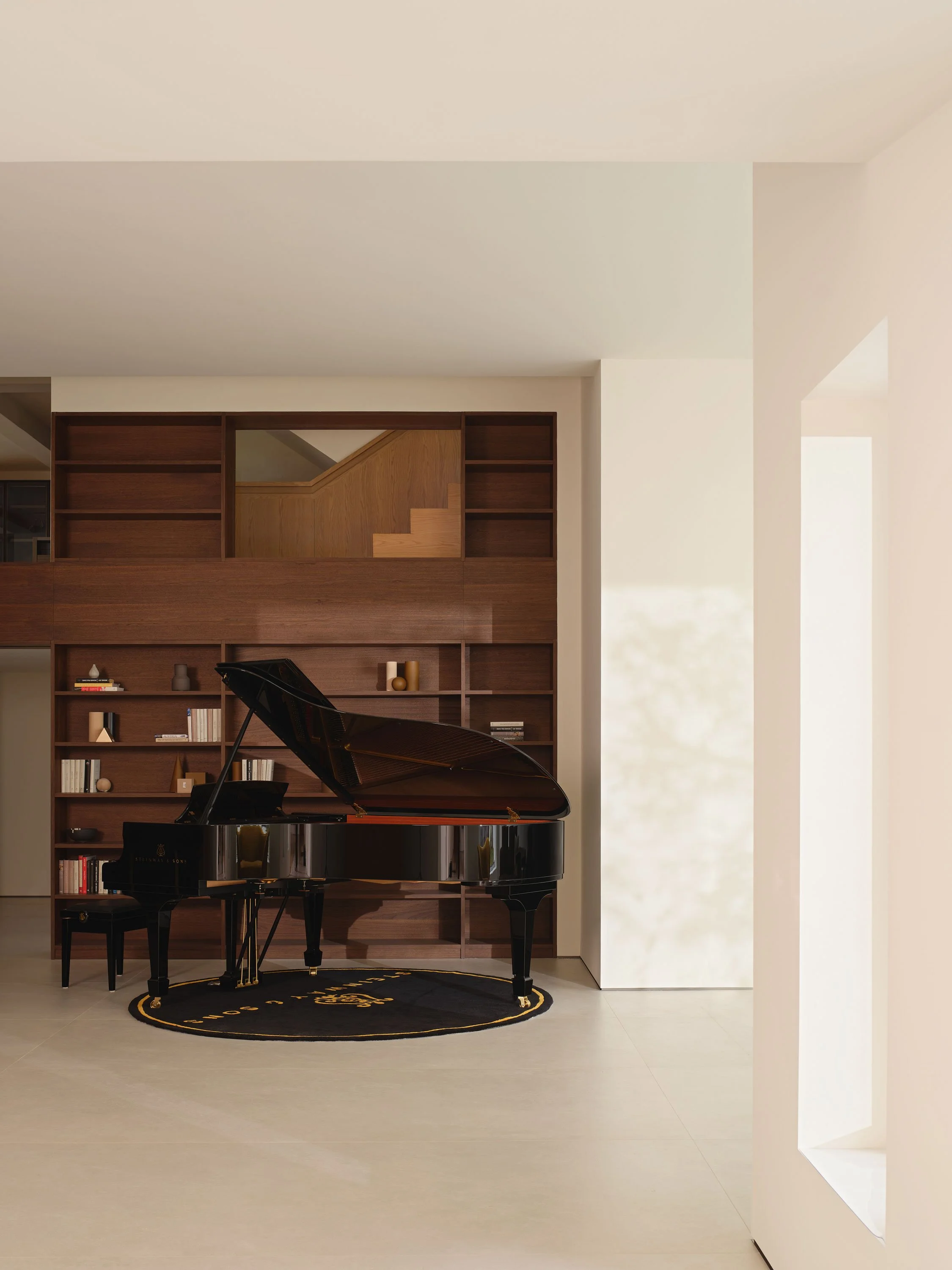
The basement level extends this philosophy quietly. A generous family reading area adopts a restrained spatial strategy, with ample ‘liubai’—the classical Chinese principle of intentional empty space—allowing daily rituals to breathe. A large public cloakroom nearby transforms a utilitarian function into an exercise in calm, its bamboo-framed light well drawing the garden downward into the lower floor.
A bamboo-framed light well draws natural light into the basement cloakroom, where flush-mounted mirrored wardrobes and a sage green ottoman demonstrate the Italian craftsmanship precision embedded throughout the residence.
By day, windows frame the courtyard like living ink-wash paintings. By night, the illuminated interior resembles an Italian design gallery suspended within a classical Chinese garden. The shift is not theatrical; it is simply what the home does as time passes.
Zhang Haihua draws his conceptual lineage from Eastern minimalist painters, from Ma Yuan to Bada Shanren, where a few brushstrokes carry the weight of an entire landscape. The question he brings to architecture is the same one those painters asked of the canvas: how little do you need to say everything?
At Pingmenli, the answer is: precisely this much.
Floor-to-ceiling walnut shelving envelops the tea room in warm grain and amber light, the Ikebana arrangement on the island counter echoing the garden's living presence deep within the lower floor.
PROJECT DETAILS
Project name: Pingmenli Private Residence
Location: Suzhou, China
Completion Year: 2024
Floor Area: 1,000㎡
Landscape area: 700㎡
Design Firm: Z+H Renhai Design
Design Director: Zhang Haihua
Design Team: Wang Xiao, Sun Huihui
Decoration Consultant: uliving
Photography: Cai Yunpu