Caffè Nazionale || A Borderland Café That Turns Alpine Tradition Into Contemporary Identity
Tarvisio has always been a place of arrival, a mountain town where Italy, Austria, and Slovenia converge, and where the act of crossing has long defined daily life.
It is fitting, then, that the town's most storied café has returned. Caffè Nazionale reopens along Tarvisio's main street, reviving a name embedded in local memory and giving it a new interior by architect Elisa Mansutti. The result is a space that does not simply reference its Alpine surroundings; it argues for them.
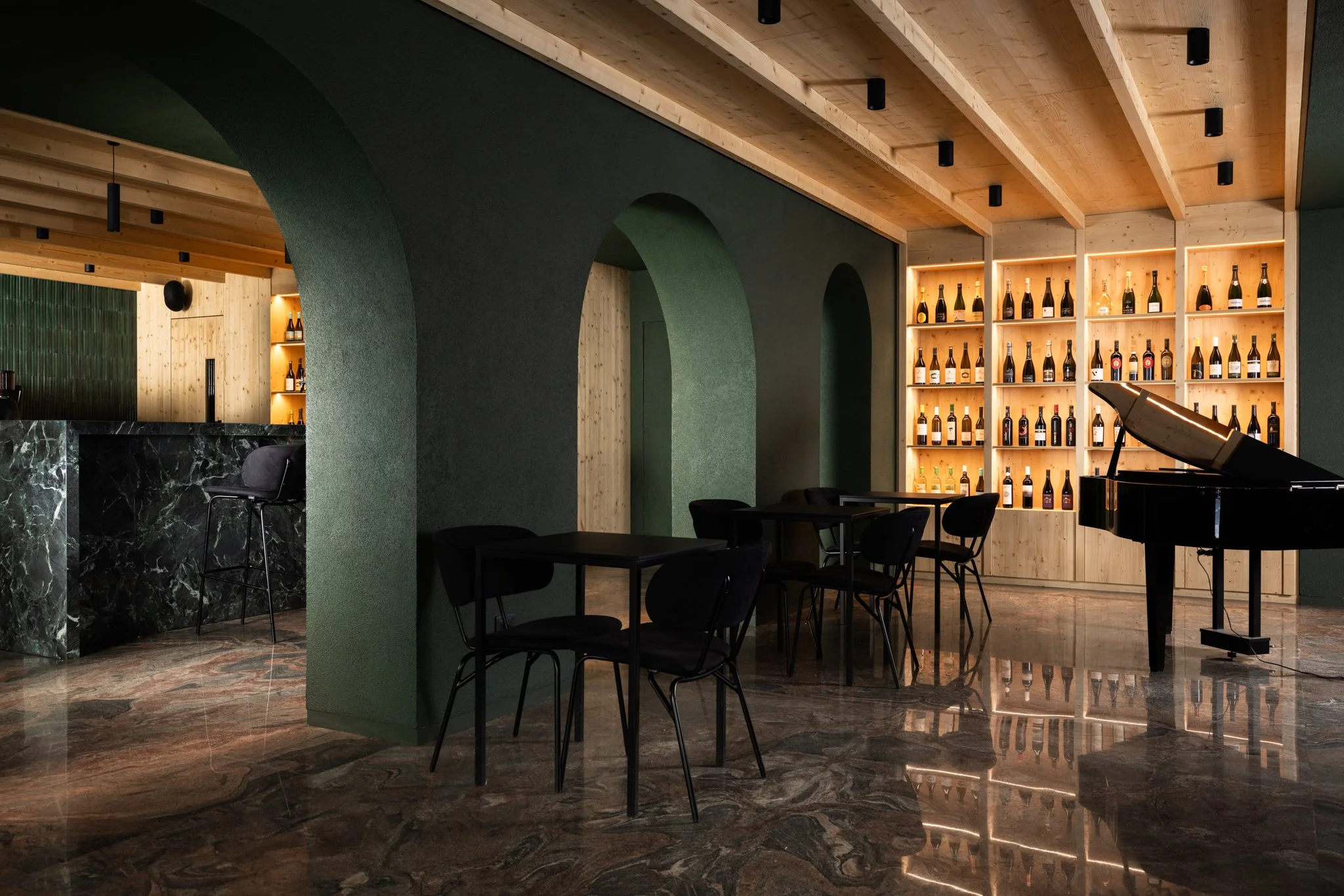
The rhythmic sequence of green-plastered arches draws the eye through the full length of the interior, separating bistro from lounge while keeping both spaces visually connected.
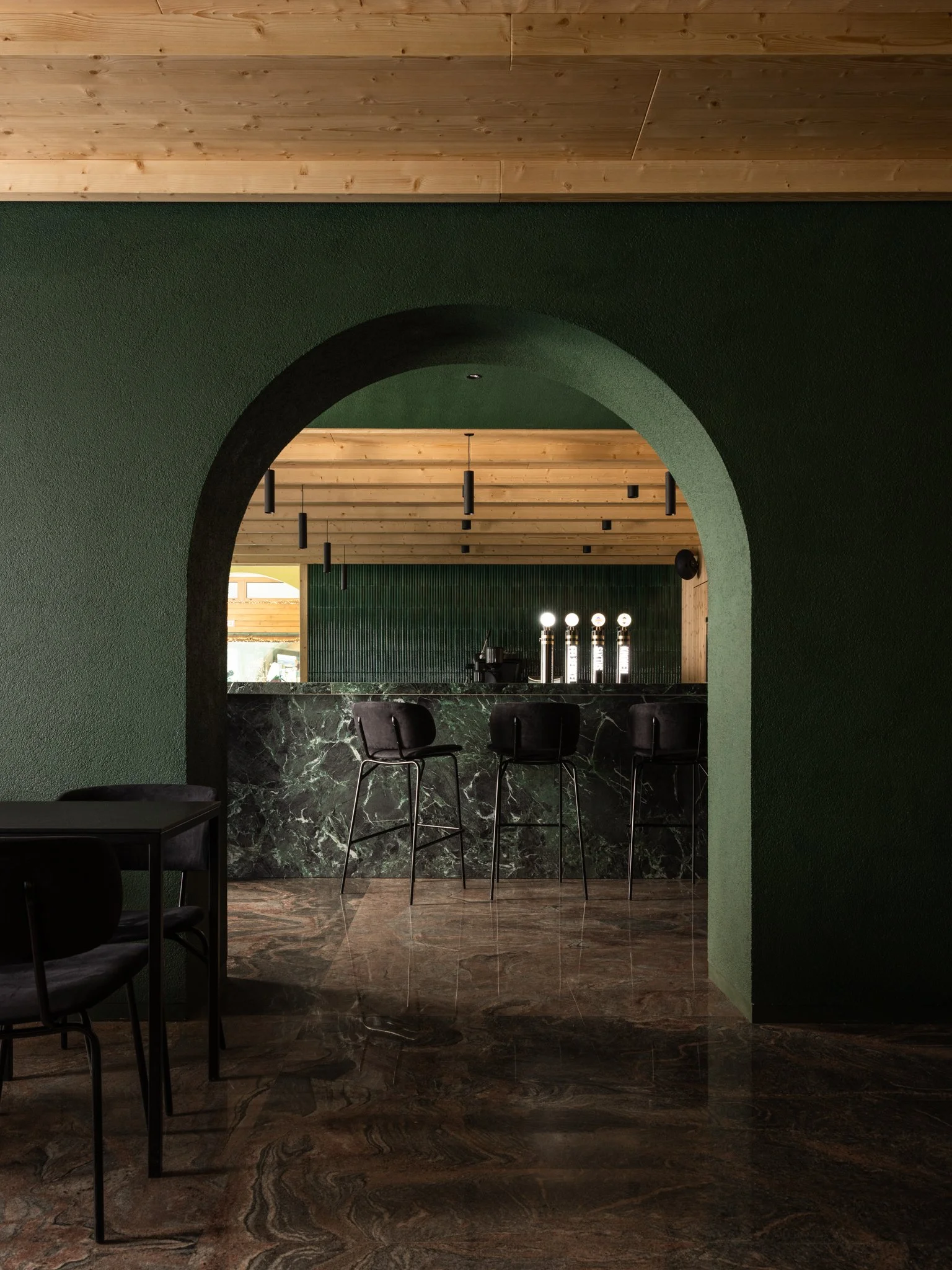
The project began with an honest reading of the site. A large, glazed commercial unit, internally divided by a sequence of structural columns, offered both constraint and opportunity. Mansutti's first move was to absorb those columns into a rhythmic wall of arches that runs the full length of the interior, separating the bistro area from the more intimate lounge beyond. Regular and unhurried, the arches establish a permeable threshold rather than a hard division; they invite the eye through without ever fully resolving what lies ahead. It is an architectural gesture that feels entirely at home in a border town.
The material palette deepens that argument. Fir wood, native to the Tarvisio Forest, clads the walls, rises into beams, and integrates seamlessly with the lighting system in a single modular rhythm based on a 60-centimetre unit. The effect is one of coherent warmth; nothing feels imported or imposed. Green marble anchors the counter, its veining echoing the existing floor, which shifts between forest green and deep reddish brown. The colour green recurs throughout, expressed through marble, glazed ceramics, textured plaster, and a living planter of snake plants at the rear of the lounge. Together, these elements build a palette that reads less as a design choice and more as a geographic fact.
A raised linear planter of snake plants, clad in glossy green ceramic tiles and edged in marble, brings the presence of the Tarvisio Forest into the lounge as living architecture. Below: Channelled green leather upholstery meets dark marble cladding and pale fir timber in a detail that distils the entire material argument of the project into a single corner.
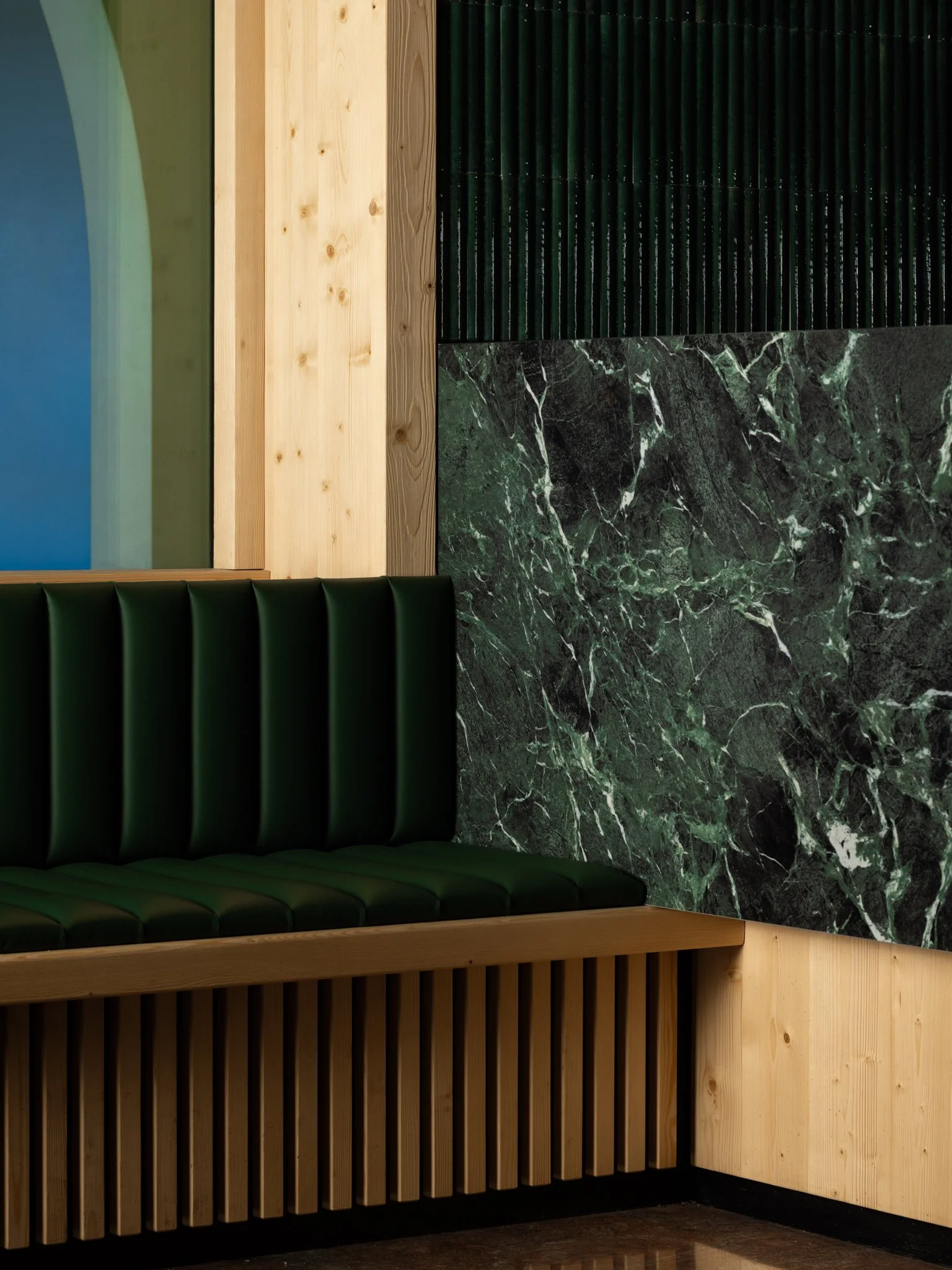
The spatial organization rewards the café's ambitions for flexibility. The bistro area handles morning coffees and weekend brunches; the lounge, more sheltered and atmospheric, opens toward aperitivo hour and evening live music performances around the resident grand piano. A green leather bench runs along the glazed façade, its slatted timber base concealing integrated heating without interrupting the visual continuity of the wood surfaces. A sculptural marble table anchors the lounge as a social centrepiece. The two zones feel distinct in character yet remain visually connected, which is precisely the point.
The L-shaped counter in veined green marble anchors the operational heart of the café, its surface continuing the geological palette established by the existing floor.
A grand piano rests beside backlit fir wood shelving in the lounge, where the café's evening identity as a live music venue takes quiet, material form.
What Mansutti has achieved here is a kind of designed hospitality that takes its cues from context rather than trend. The arches recall the porticoes of northern Italian civic architecture; the fir wood is the forest made interior; the marble is the mountain made counter. None of it announces itself. All of it coheres.
Caffè Nazionale is not trying to be anywhere else. In a town that has always lived between borders, that clarity of belonging is, quietly, radical.
PROJECT DETAILS
Architectural design and site supervision: Arch. Elisa Mansutti
Mechanical and plumbing design: Ing. Paolo Di Leo
Electrical design: Ing. Stefano Toscani
Custom-made carpentry works: Artigiani del Legno (Buja, UD)
Mechanical and plumbing installation: TCM Impianti (Tarvisio, UD)
Electrical installation: Baraldi Mario (Tarvisio, UD)
Photographer: Dario Borruto