Gilay Estate || A 40m² Off-Grid Retreat That Builds with Country, Not Just on It
On the Liverpool Plains, a 40m² structure clad in charred timber asks a question most architecture never thinks to pose: what does it mean to build with permission?
Gilay Estate, a luxury off-grid farm stay set on a working property just outside Quirindi in regional New South Wales, is not a large building. But it carries significant weight. Designed to sit on gently undulating land with uninterrupted views across the Liverpool Plains, the project began not with a floor plan but with a conversation, an extensive consultation with the local Aboriginal lands council that shaped the building's material identity from the ground up.
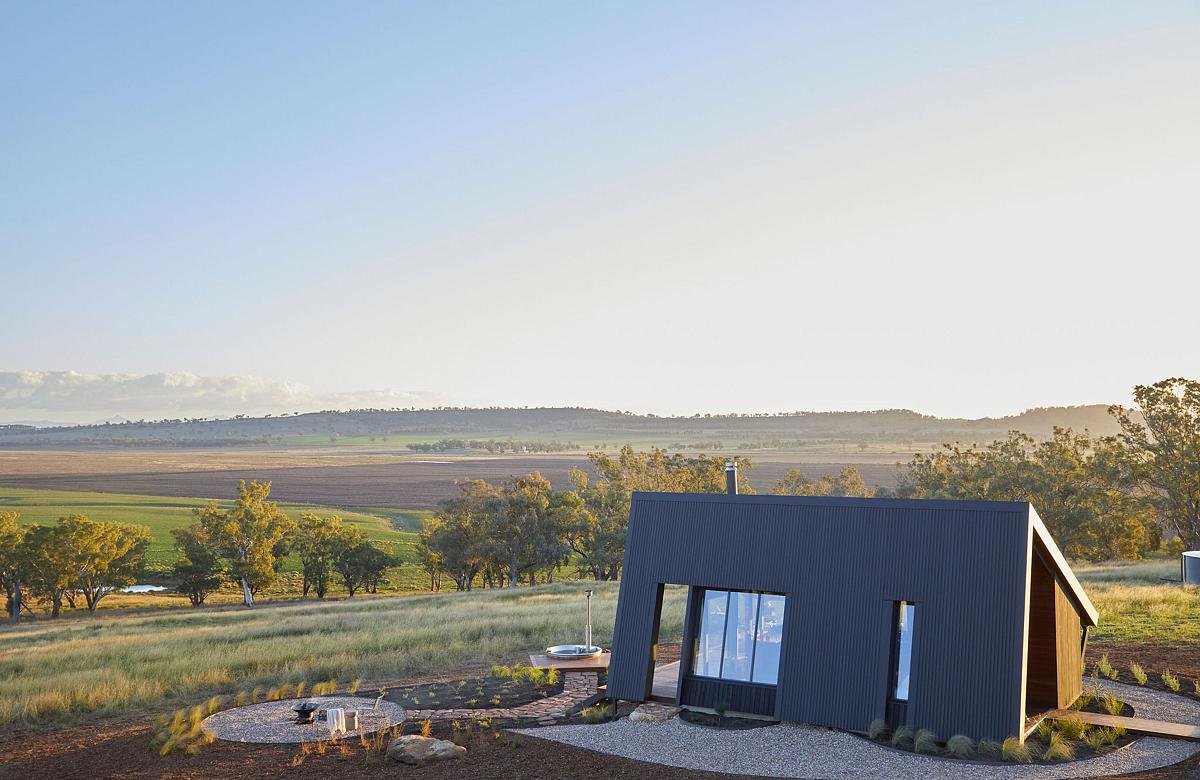
The asymmetric sheet metal roof and charred timber cladding allow Gilay Estate to dissolve into the Liverpool Plains rather than interrupt them.
The charred timber cladding that wraps the exterior is the most visible result of that process. It references traditional burning practices: a land management technique as old as the Country itself, used to clear, regenerate, and renew. Against the open plains, the dark cladding allows the building to recede into the landscape rather than assert itself over it.
Step inside, and the palette shifts entirely. Warm timber lines the interior walls and ceiling, a deliberate contrast that represents regrowth and healing—the regenerative stage that follows the burn. In a building of just 40 square metres, that symbolic conversation between exterior and interior carries real architectural intelligence.
Floor-to-ceiling glazing frames an unbroken view of the plains from the living area, where a wood-burning stove holds the room's warmth against the vastness outside.
The form is equally considered. A roof wrapped in sheet metal mimics the enclosure of a tent structure, evoking shelter in its most elemental sense. A large curved cutaway in the roofline maximizes views to the west while maintaining generous overhangs that shade the interior through summer. Extensive double glazing to the south captures the plains in full; northern and western glazing is carefully protected. The building understands its orientation as intimately as it understands its site.
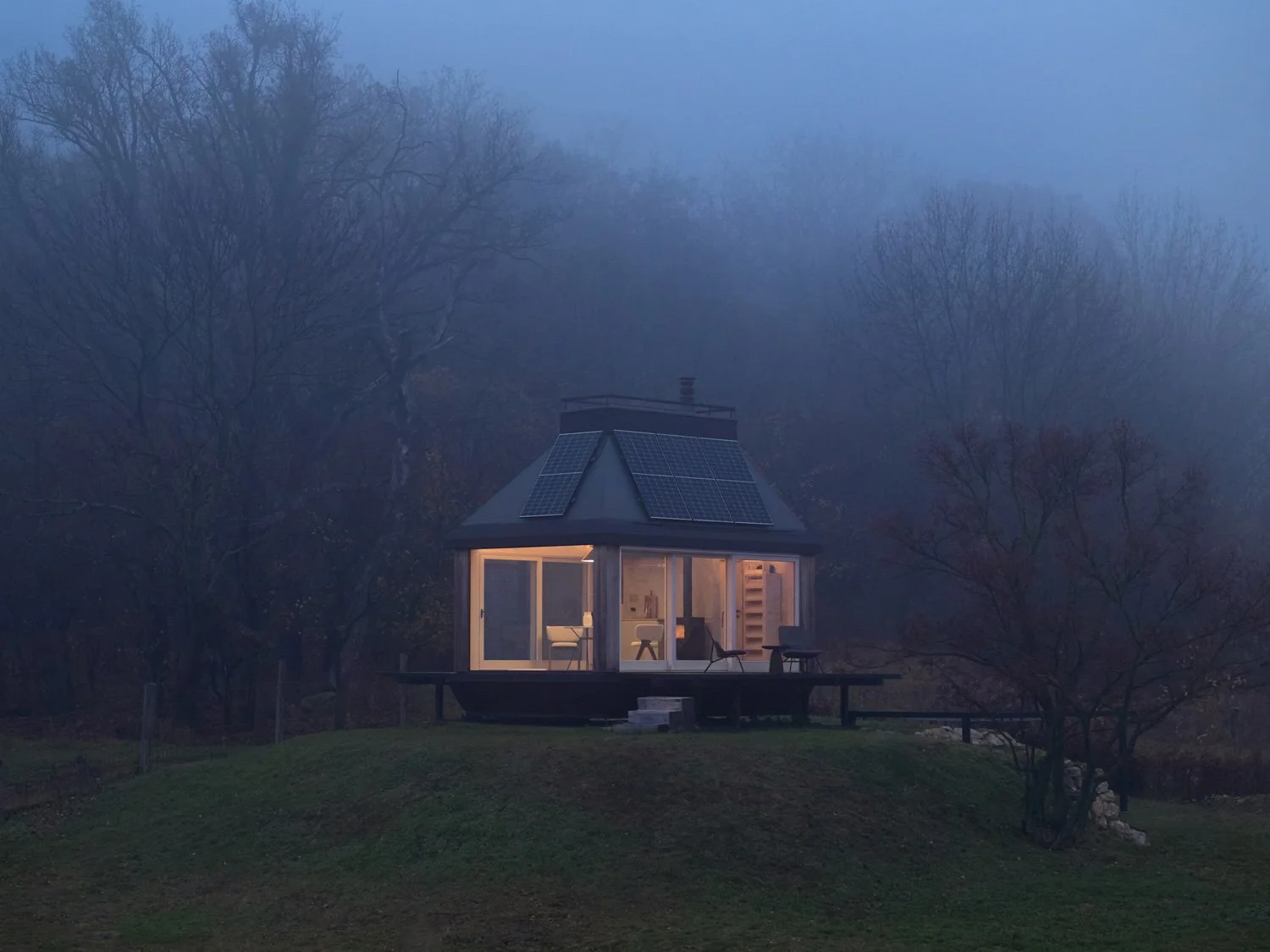
Off-grid function is handled with equal rigour. A 6.4kW solar system paired with 11.4kW of battery storage powers the retreat entirely, while a 60,000-litre rainwater tank supplies all water needs within the building. Double-glazed windows and doors, thermal mass, and native landscape plantings complete a sustainability framework that is practical and holistic in equal measure. Even the kitchen joinery makes use of off-cut building materials, a detail that speaks to a broader ethic of minimal waste and considered making.
Walnut-toned timber cladding, rust-hued linen, and a fluted stone side table bring tactile warmth to the sleeping space tucked within Gilay Estate's open-plan interior.
Terracotta low-slung seating and warm timber wall panelling create an interior that reads as shelter in its most considered form, with the fireplace casting light across polished terrazzo floors.
The interior is open plan by necessity and by intention. The sleeping space sits within the main living area, oriented toward the view. A wood-burning stove anchors the living zone, its fire visible through glass — warmth made literal. A private bathroom, tucked discreetly away, offers its own westward outlook, turning even the most utilitarian moment of the stay into something quietly remarkable. Terrazzo floors ground the space with texture and thermal mass, while low-slung furniture in warm terracotta tones keeps the atmosphere unhurried.
Dark stone tiles and a brushed brass rain shower head in the bathroom, tucked away discreetly beside the kitchen.
Gilay Estate was conceived to establish Quirindi as a tourism destination and to offer couples a genuinely rare experience: a place remote enough to demand presence, beautiful enough to reward it, and honest enough to mean something. On the Liverpool Plains, architecture doesn't need to be grand to matter. It just needs to listen.
A fire bowl smoulders at dusk on the gravel terrace, the wood-fired soaking tub and open plains beyond completing a scene of intentional stillness.
PROJECT DETAILS
Project size: 40 m2
Completion date: 2024
Building levels: 1
Architects: Cameron Anderson Architects
Collaborators: Blacklab Solar, Kelley Covey Group, Somewhere Landscape Architects, Morning Swim Studio, Aztek Constructions
Photographer: Morning Swim Studio