Casa Santa María del Oro || A Low-Impact Home Designed to Protect a Volcanic Crater Lake
The most responsible thing a building can do, sometimes, is almost nothing at all.
Nestled into a steep hillside in Santa María del Oro, Nayarit, Casa Santa María del Oro is a residential project that treats its site not as a canvas but as a contract. Designed by Mauricio Ceballos X Architects, the house sits at the edge of a volcanic crater lake, one of Mexico's most fragile freshwater ecosystems, where any construction misstep carries consequences far beyond the property line.
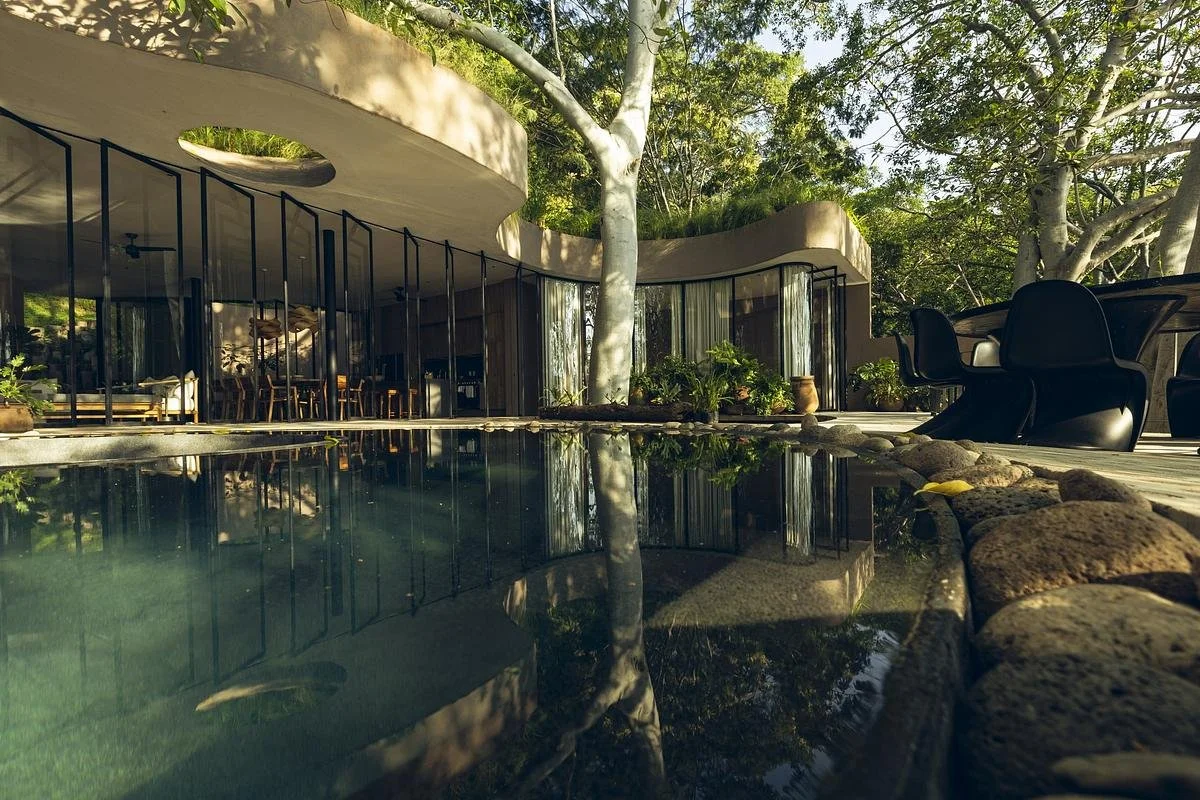
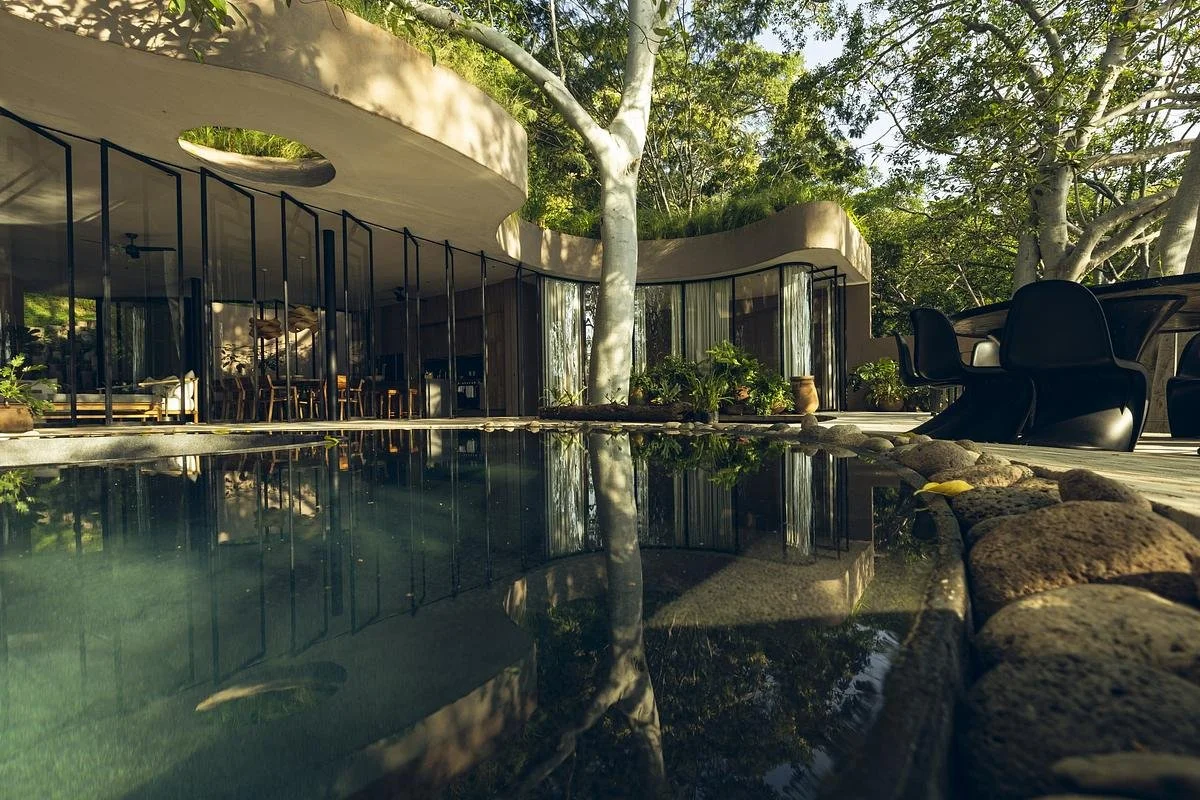
The circular pool and curved building volume reflect the canopy of ancestral trees, their forms inseparable from the architecture that was shaped around them.
The challenge was significant: a constrained budget, a steep slope, a modest street-facing facade, and five ancestral trees whose presence was non-negotiable. Rather than working around these conditions, the architects made them the design. Circular voids were subtracted from the building volume to accommodate the trees, allowing the canopy to intertwine with the structure. The house itself was tucked entirely within the slope, leaving only terraces visible from the lake. From most vantage points, it barely registers as built.
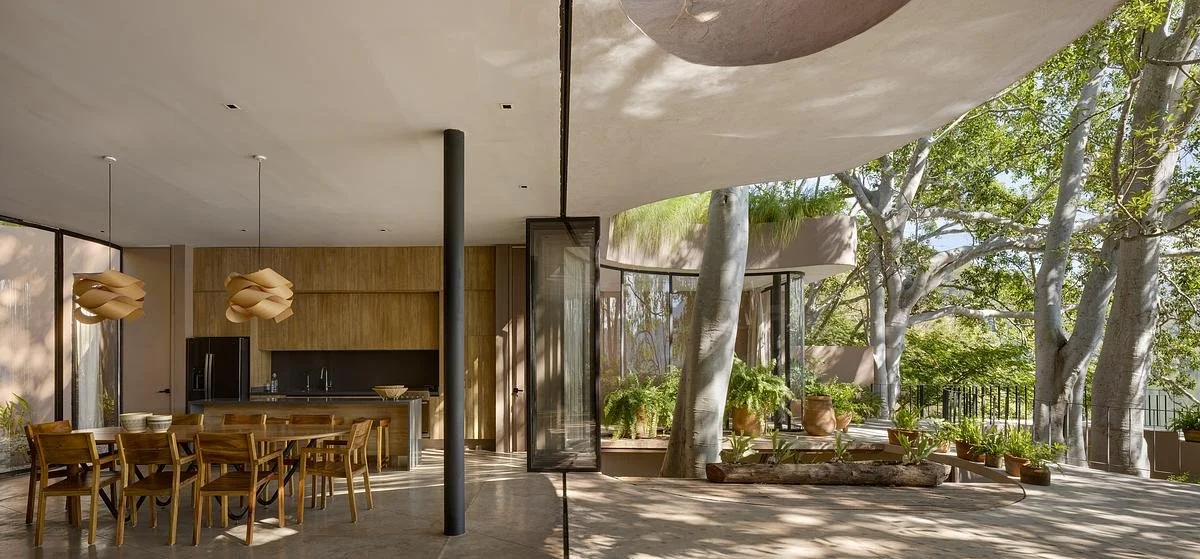
Circular voids cut through the roofline allow the trunks of five protected trees to pass directly through the structure, dissolving the boundary between interior and canopy.
That invisibility is intentional. The green roof camouflages the structure within its hillside setting while providing thermal insulation that reduces mechanical cooling loads. Natural cross-ventilation is achieved by positioning interior courtyards around existing trees, drawing air through the plan without relying on energy-intensive systems. Low-energy equipment and LED lighting further reduce operational consumption; solar panels are planned for a future phase on an adjacent plot with optimal sun exposure.
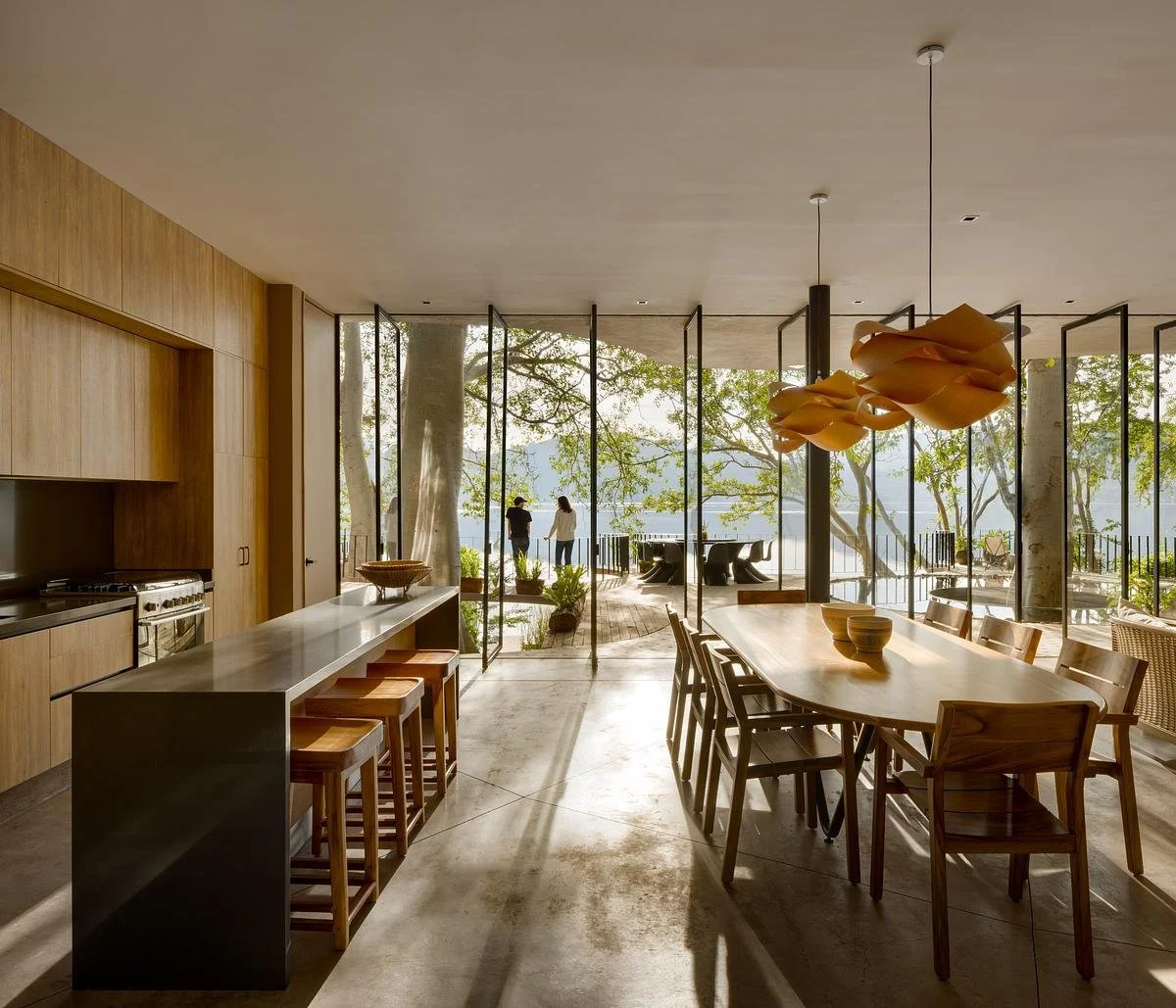
Warm timber joinery and a sculptural pendant light anchor the kitchen and dining area, where full-height glazing frames the crater lake beyond the ancestral tree line.
Water management received equal care, given the crater lake's sensitivity to contamination. Rainwater is collected and filtered on-site. Blackwater is separated from stormwater and processed in biodigesters before passing through filtration systems and into absorption wells that promote oxygenation, preventing harmful runoff from reaching the lake below.
Material choices reinforce the low-impact brief. Reduced concrete and masonry give way to locally sourced stone, selected for its durability and minimal impact on installation. Furniture incorporates volcanic stone native to the geothermal region alongside wood reclaimed from construction formwork, embodying circular economy principles without sacrificing warmth. Wall finishes draw from Nayarit's earthy palette of browns and beiges, grounding the interiors in their regional context while maintaining a quietly contemporary sensibility.
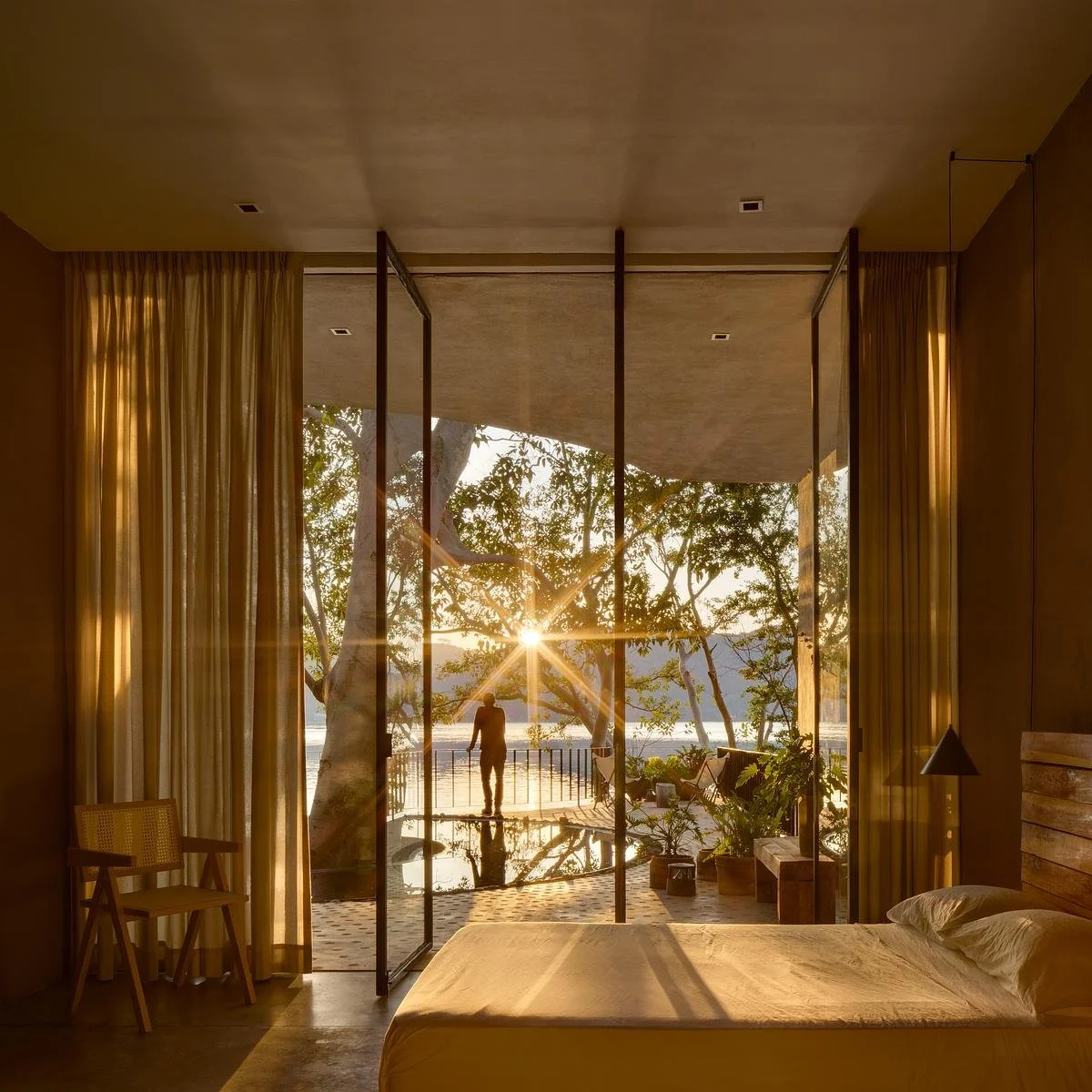
Golden light floods the bedroom, the lake shimmering through the trees in the distance.
The programme is deliberately simple: three bedrooms, a central social space, and a generous terrace with a circular pool oriented toward the lake. A 20-metre entrance staircase, built from prefabricated cylindrical concrete steps with deliberate spacing, doubles as a rainwater diversion system, channelling water away from the structure and into the landscape. Nothing here does only one thing.
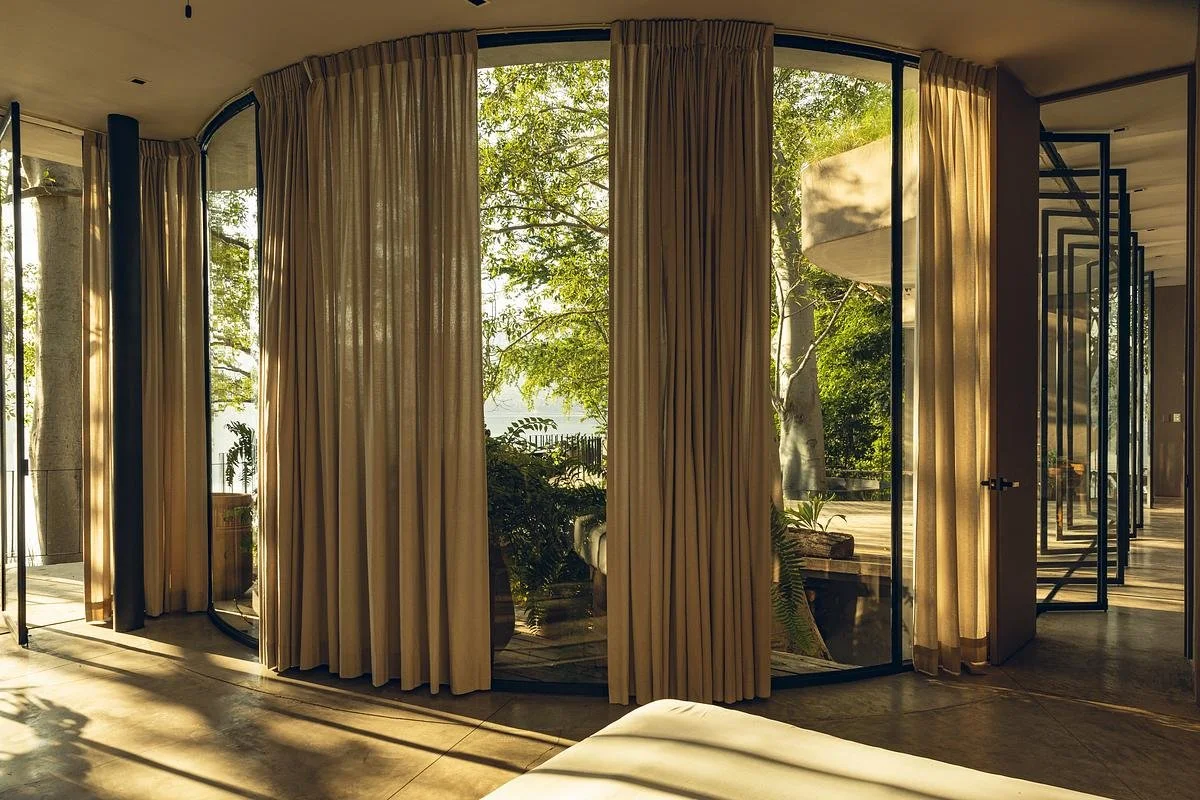
Seen through curved floor-to-ceiling glazing at dusk, the circular terrace and its surrounding tree canopy reveal the house's quiet orientation toward the volcanic crater lake.
What makes Casa Santa María del Oro instructive for sustainable residential design is not any single strategy but the coherence of its thinking. Ecological sensitivity, cultural respect, community collaboration, and architectural ambition are treated as compatible rather than competing values. The result is a house that earns its place on a fragile piece of land, not by dominating it, but by understanding that the best architecture sometimes leaves the lightest mark.
The earthen facade and terraced gardens dissolve into the hillside vegetation, demonstrating how completely the house was designed to remain hidden.
PROJECT DETAILS
Project size: 250 m²
Completion date: 2022
Architect: Mauricio Ceballos X Architects
Photographer: Rafael Gamo
Location: Santa María del Oro, Nayarit, Mexico