CLEMENTINE HOUSE || How a Český Krumlov Boutique Hotel Turned Individual Room Design Into an Art Form
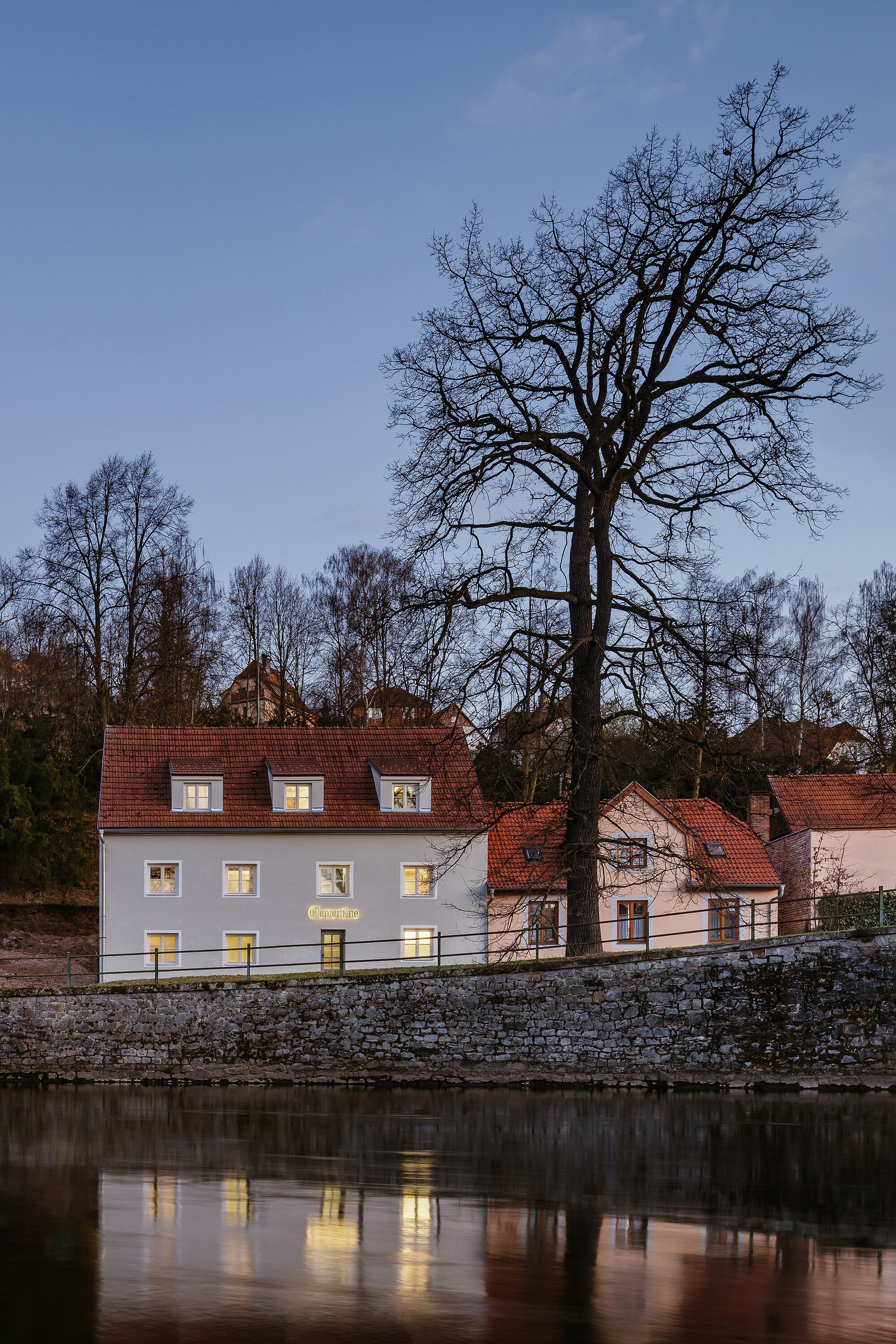
Český Krumlov has always drawn visitors to its medieval riverbanks, but Clementine House gives them a reason to linger inside.
When Anna Gášpárová acquired the late-18th-century farm building on the Vltava River in Český Krumlov in 2019, she wanted to create a place where she herself would want to stay. She engaged her close friends, architects Lucie Němcová and Tereza Komárková, to reimagine the building. The result is a guesthouse that unfolds as five distinct rooms, each with its own material identity and mood.
The historic renovation of this farmhouse in the Czech Republic preserved only what was irreplaceable: exposed timber beams and raw stone walls. Everything added is contemporary, honest, and functional. The architects describe their approach as creating a clean canvas for art and life, and that restraint is precisely what gives each room room to breathe and to differentiate.
The dark blue steel staircase, fabricated by Petr Hampl, threads the full height of Clementine House, transforming a structural necessity into the defining gesture of the renovation.
The ground-floor entry immediately announces the building's ambitions. A dark blue steel staircase winds from the entry hall to the attic, its sculptural form cutting through the house's vertical stack and connecting all levels into a continuous whole. It is not incidental; it is the spine of the project, and the looping pendant light above it reads as punctuation.
An arched passage connects the living area to the sleeping alcove, where blonde oak, a sculptural dining table, and Patrik Hábl's painted panels compose a room with the warmth of a place lived in over time.
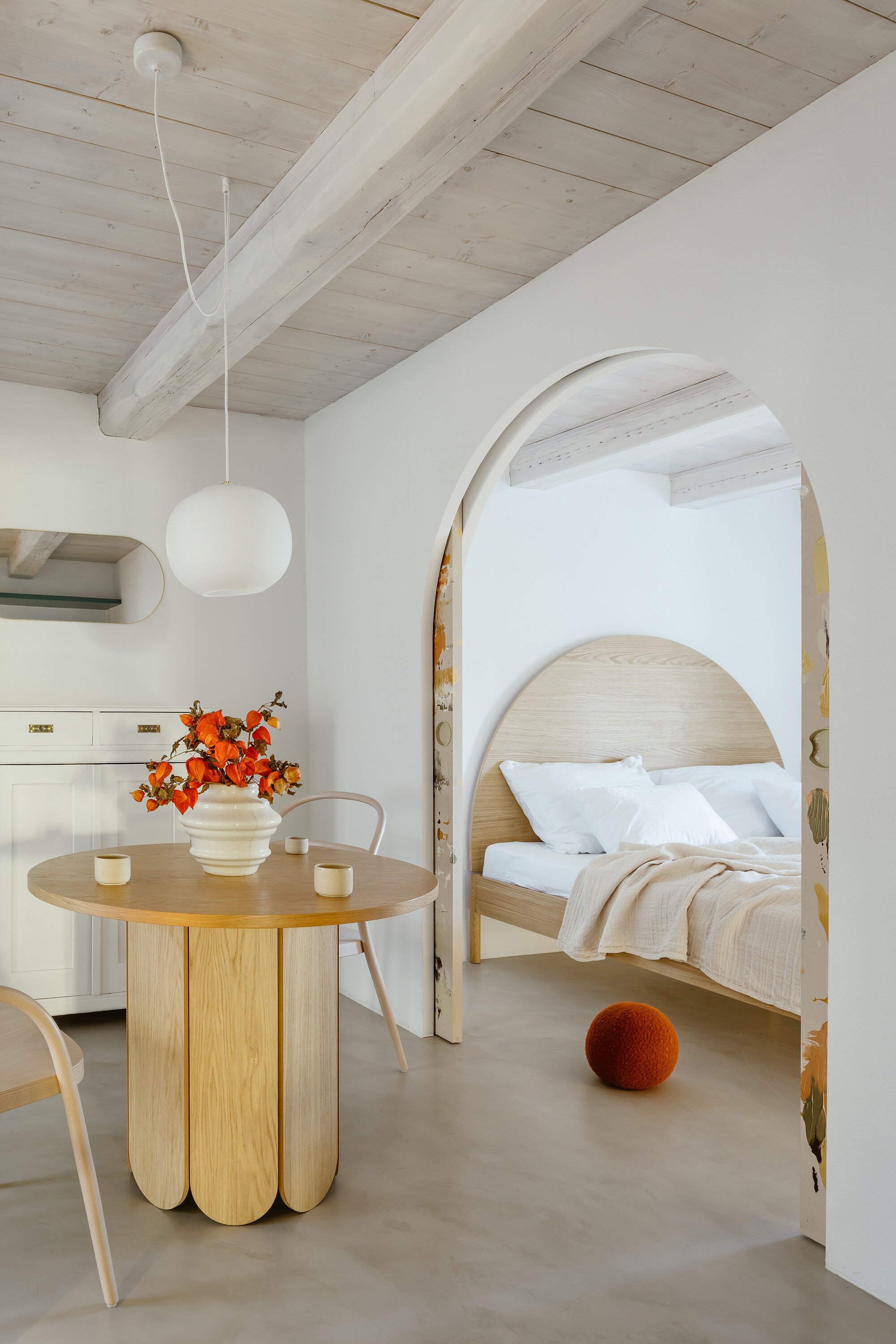
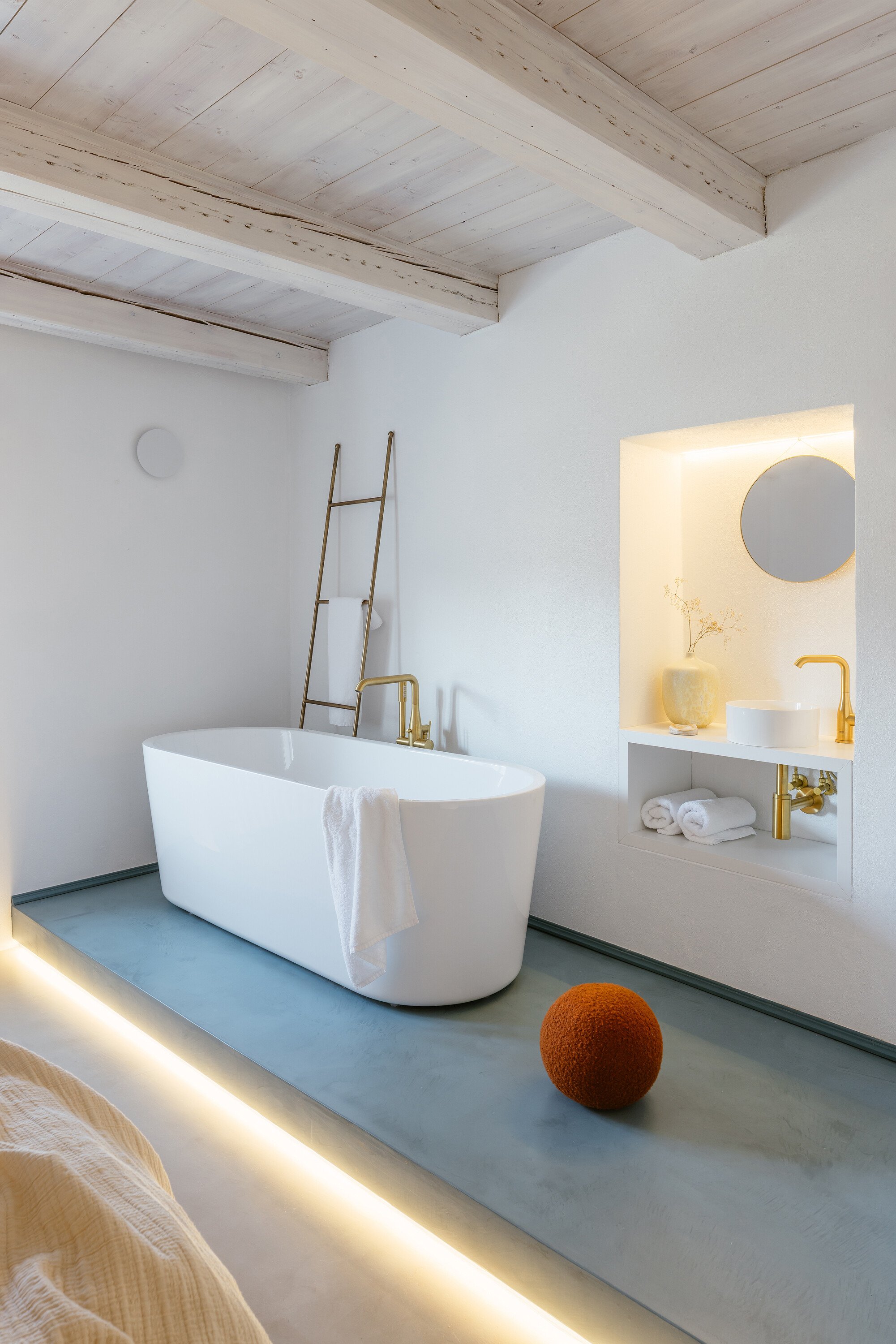
On the first floor, two spacious apartments overlook the river and the newly composed garden. Their layouts can be reconfigured using large-format sliding panels that double as original paintings by Czech artist Patrik Hábl. In the warmer of the two, blonde oak furniture, a sculptural dining table with rounded legs, an arched passage to the sleeping alcove, and brass fixtures give the space an unhurried, almost Mediterranean warmth. Its bathroom is raised on a platform edged in soft blue resin, with a freestanding tub and built-in niche finished in illuminated plaster.
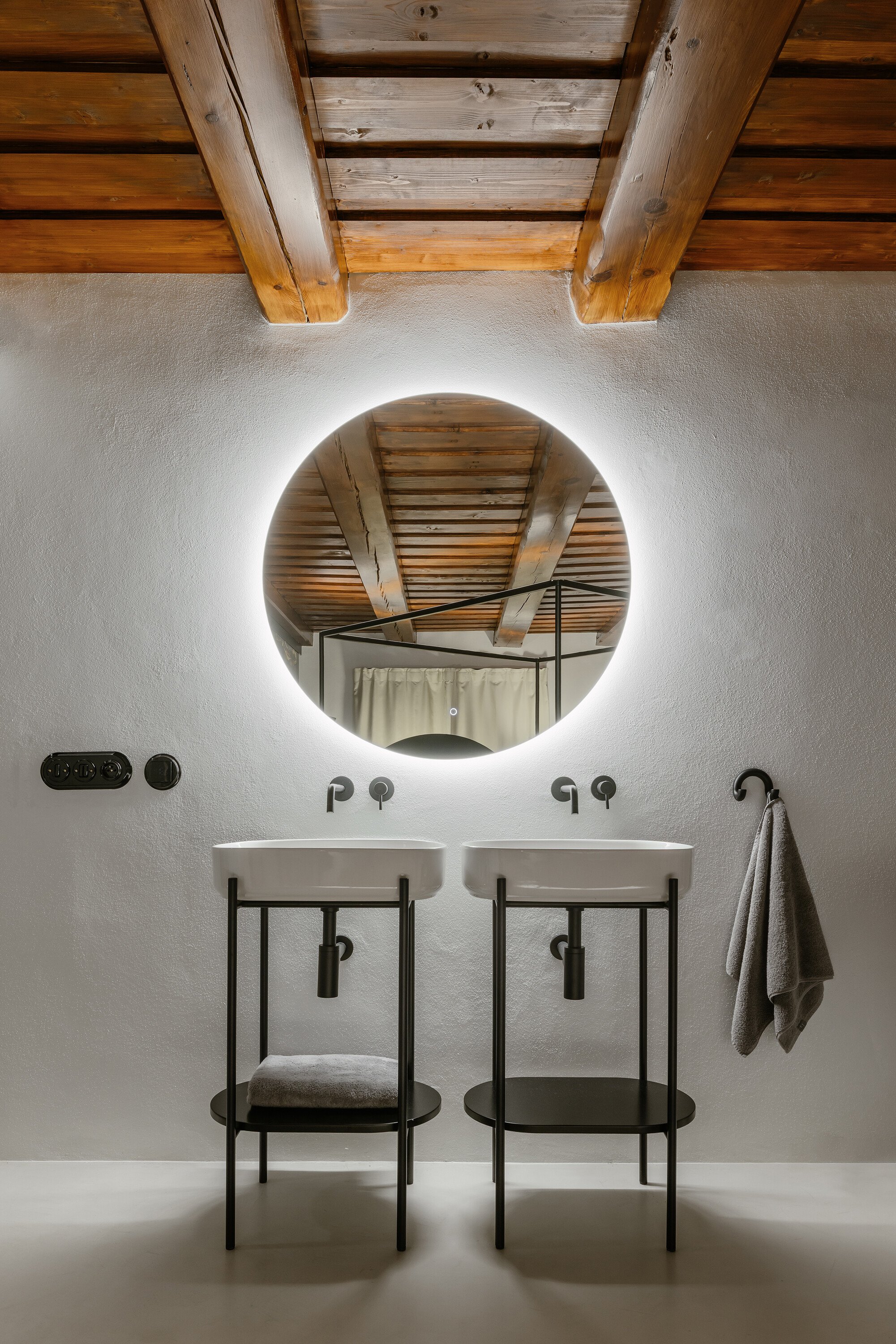
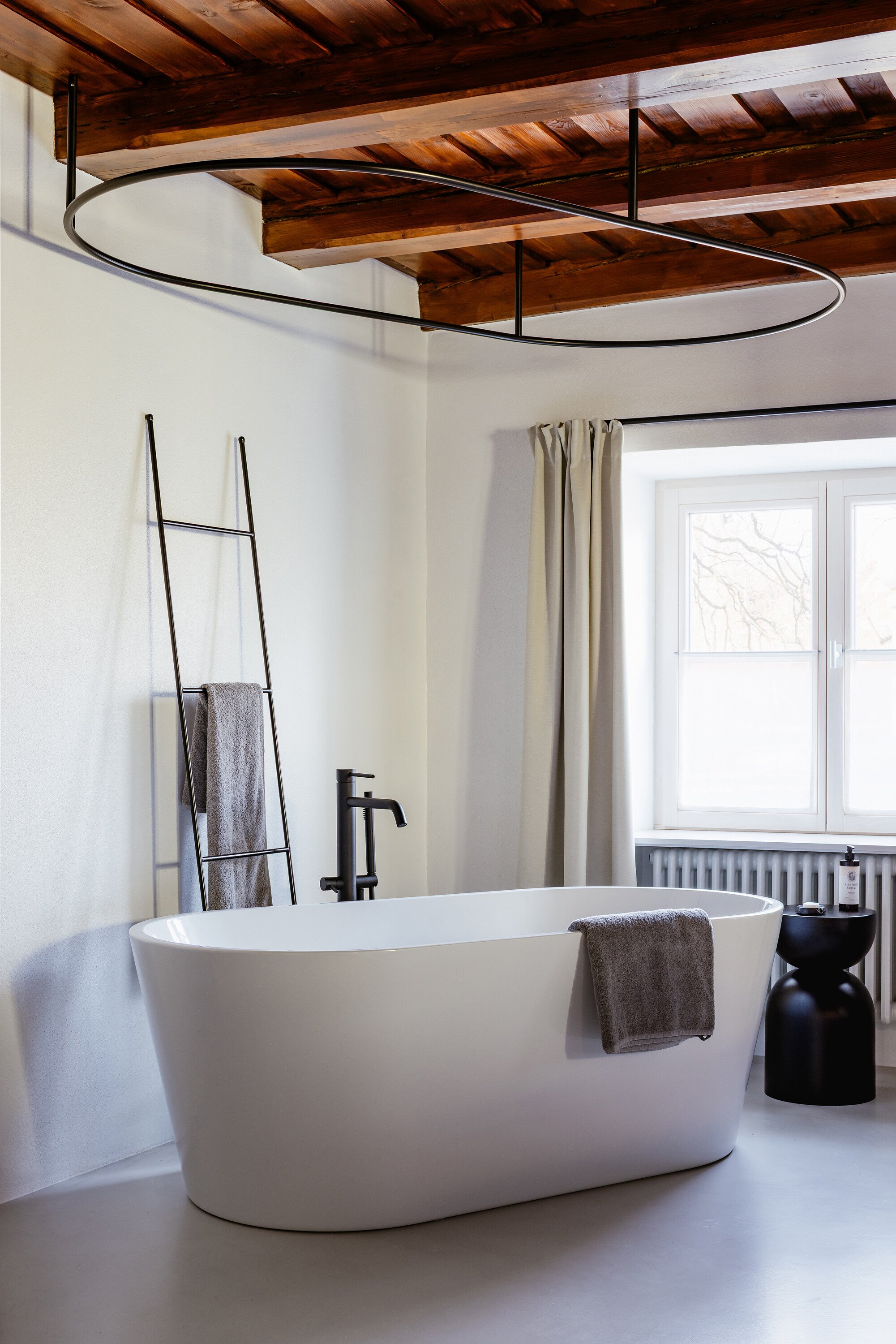
In the second first-floor apartment, the palette shifts: rich wooden ceilings, a steel four-poster bed on casters, and open-plan bathing integrated into the bedroom reinforce a sense of personal ritual. Hábl's paintings appear here as backlit panels behind the bed, their gestural marks pulling the room into a more dramatic register.
The steel four-poster bed on casters, set against Hábl's backlit panels and beneath original timber beams, anchors a room where the boundary between sleeping and bathing dissolves.
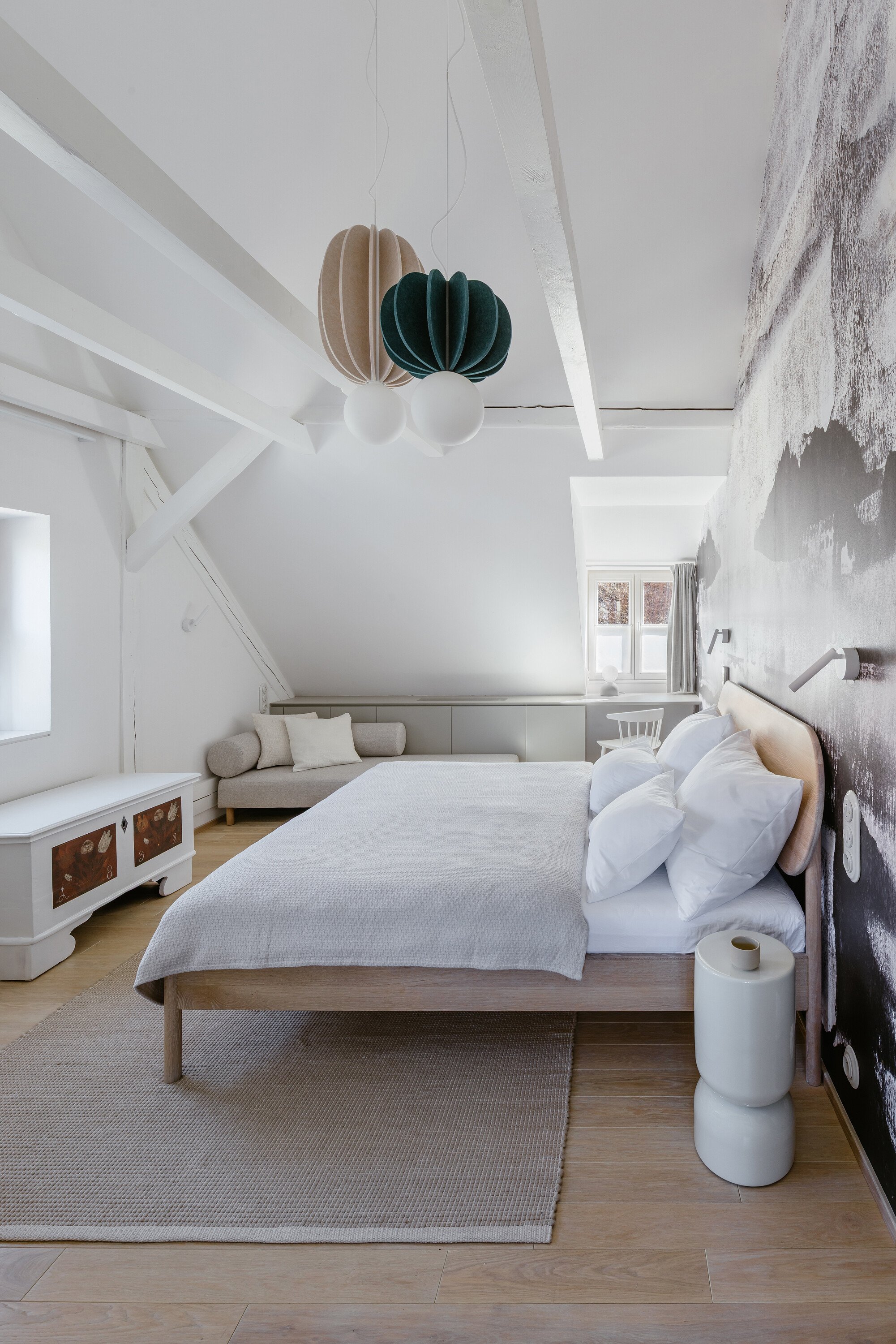
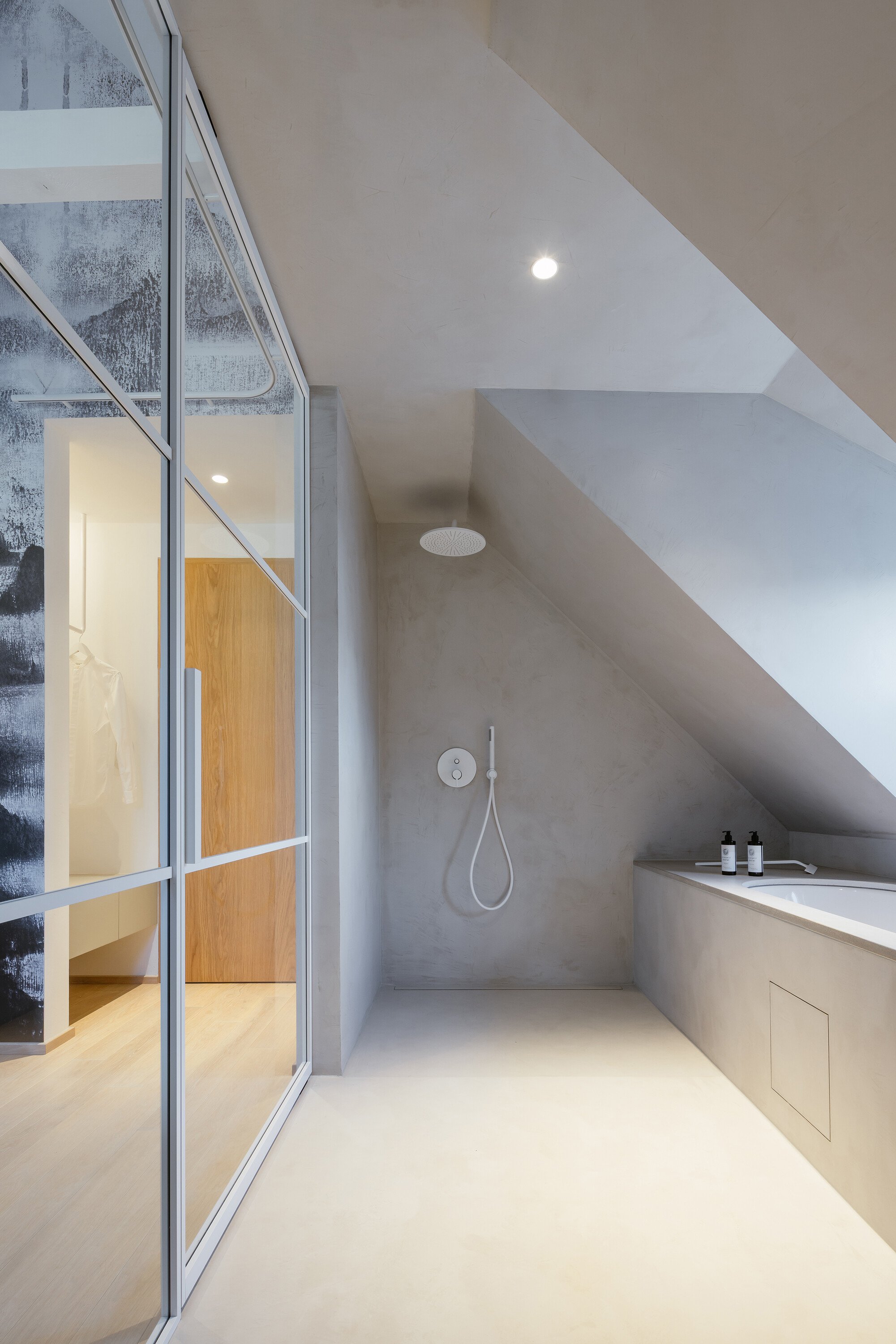
Up in the attic, three rooms work with the geometry of the roof as a design feature rather than a constraint. One room wraps its bathroom entirely in sage-green cement plaster, the angled ceiling planes turning the shower enclosure into something closer to a grotto. Another keeps its palette spare and graphic, with a monochrome wall mural derived from Hábl's painting language and a built-in bath tucked beneath the roofline. A third takes the most intimate approach, with a low custom oak bench running the full width of the room, exposed stone walls painted white, and a sage kitchen in the adjacent living space.
A monochrome wall mural derived from Hábl's painting language wraps the attic bedroom, the oak headboard and globe lamp holding their own against the graphic intensity of the surface.
The third attic apartment takes a more intimate approach with a custom oak bench running the length of the room.
Across all five rooms, the level of material craft is consistent: hand-applied cement plasters by BOCA, custom joinery by HOMER Concept and Interiors, stone slabs by Adriatik Stone, and metalwork by Bers Metal. Loose furniture mixes restored antiques with pieces by Czech and Slovak designers, sourced with the same care as the fixed elements.
What Komárková and Němcová have built at Clementine House is an argument for individualized hospitality design as a meaningful alternative to brand consistency. Each room at this boutique hotel in Český Krumlov shares something different with its guests, and, in doing so, it offers something most hotels cannot: the feeling that the space was made with a particular kind of person in mind.
In the attic bathroom, sage-green cement plaster by BOCA coats every surface, turning the angles of the roofline into the room's architecture.
PROJECT DETAILS
Studio
Architéka
Lucie Němcová
Author: Tereza Komárková [Architéka], Lucie Němcová
Website:
Social media:
Design team:
Tereza Černá [collaboration]
Stanislav Heidler
Blanka Heidlerová [project documentation]
Client: Anna Gášpárová, Gergely Gášpár
Project location: Po Vodě 106, Český Krumlov
Project country: Czech Republic
Completion year: 2026
Built-up area: 140 m²
Gross floor area: 490 m²
Usable floor area: 320 m²
Photographer: Václav Novák
Collaborators and suppliers:
Original artistic wall paintings: Patrik Hábl
Wayfinding: Brandmark.
Sticker graphics, wallpapers [implementation]: FUGU
General contractor: Vidox
Atypical steel staircase: Petr Hampl
Cement plasters: BOCA
Wooden floors & tiles: Havwoods
Custom furniture: HOMER Concept & Interiors
Stone slabs: Adriatik Stone
Locksmith elements: Bers Metal
Atypical concrete slabs for bathtubs: ŠVEC Beton
Lighting supplier: LightWorks
Decorative chandeliers: Studio IHOR
Furniture supplier: Momenti, Alax, Bonami
Restoration of antique furniture: Tereza Korbelová [sto•re]