North Bank Road || Biophilic Forest Home in Washington's North Cascades Balances Shelter, Wildness, and Climate Resilience
In the ancient conifer forests of Washington's North Cascades, where winter snowfall is heavy and summer sun is relentless, the most considered response to the landscape is calibration.
That calibration is evident from the first approach to 9 North Bank Road, a family home near Mazama set within a dense pine forest at the edge of a glacial valley. The building recedes into its surroundings with the same quiet authority as the conifers that frame it, its barn-inspired form drawn directly from the region's vernacular architecture.
The barn form was not a stylistic choice so much as a practical one. Pierre Maré Architects recognized in it an economy of expression well-suited to the demands of the North Cascades climate: a pitched roofline capable of managing heavy snow load, a compact volume that resists heat loss, and a simple silhouette that reads as native to the landscape. Pre-weathered cladding and a highly insulated wall construction extend that pragmatism to the building envelope, ensuring the home is as hardwearing as it is considered.
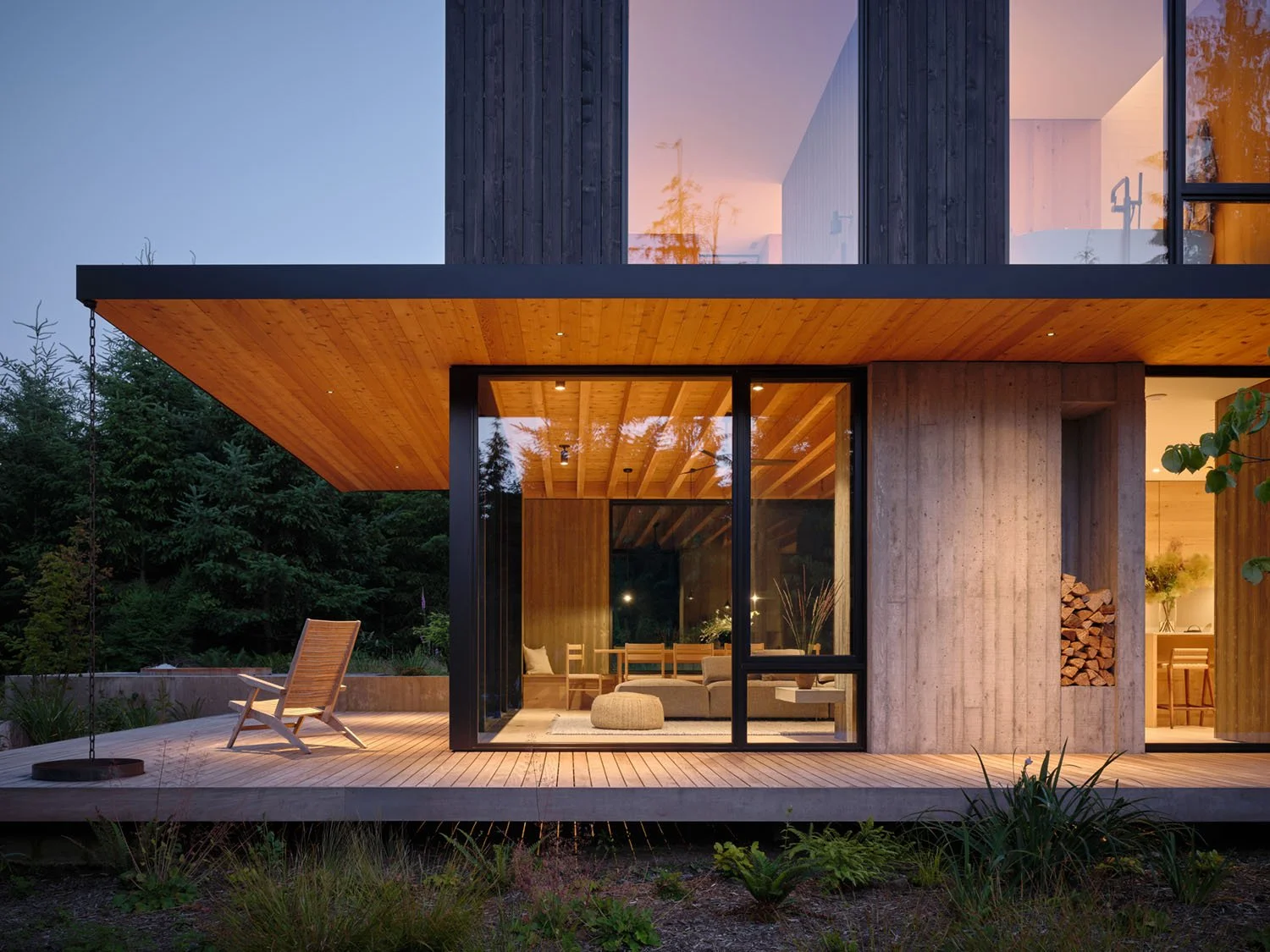
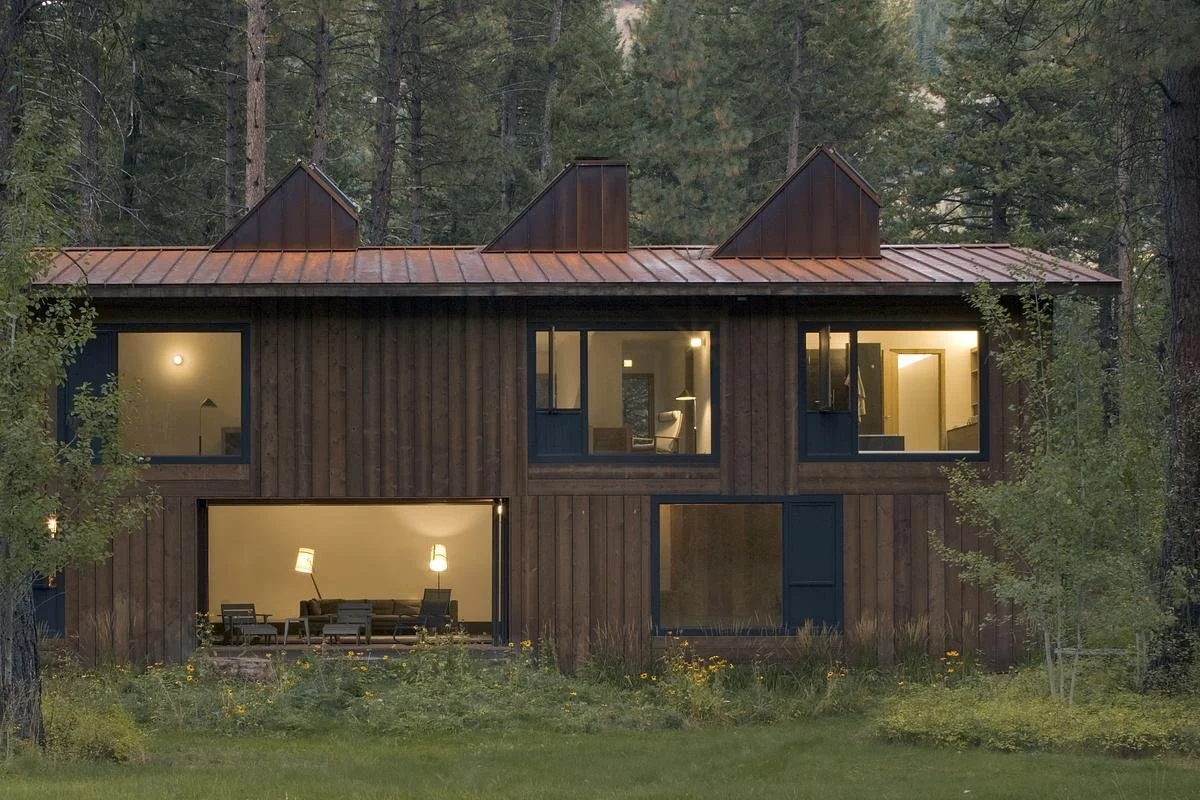
The pre-weathered timber facade recedes into the pine forest at dusk, its barn-inspired silhouette shaped as much by the North Cascades climate as by design intent.
Folding timber-framed panels dissolve the boundary between the main living area and the forest deck, pulling pine trunks and dappled light directly into the domestic frame.
Where the design becomes most inventive is at its edges. Screened porches are woven into the building volume, creating an intermediate zone between interior life and the forest beyond, a threshold that is neither fully inside nor fully outside. This managed boundary allows the forest to remain present without overwhelming domestic life, framing views of pine trunks and forest undergrowth as if the landscape itself were a considered interior element.
Inside, the spatial logic continues that conversation with light and landscape. A series of interlocking spaces draws daylight in from above the tree canopy, and a predominantly white interior finish amplifies what the forest filters. Selected areas of oak, used for wall panelling, cabinetry, and joinery, introduce warmth against the white, while basalt stone flooring grounds the interior with material weight and texture.
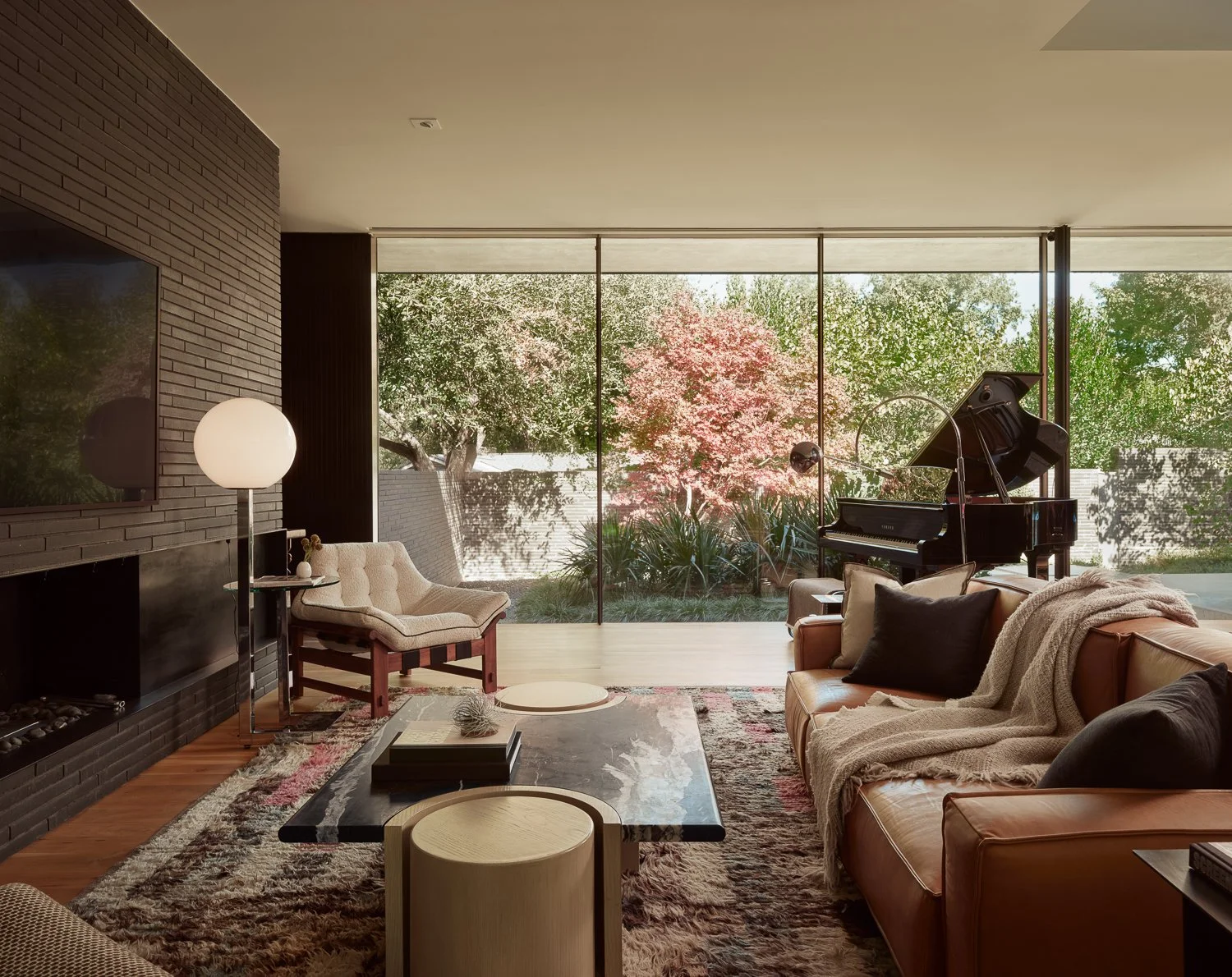
Blackened steel and dark stone anchor the fireplace wall against a surround of warm oak panelling, the lit hearth drawing the room's material palette into sharp relief.
The oak balustrade of the upper landing traces a clean horizontal line, while the skylight spills natural light into the living area below.
Industrial pendants cast an even wash of light across the kitchen island and dining table, the oak cabinetry and dark stone countertops reinforcing the home's grounded material language.
The kitchen anchors the communal heart of the home, with a substantial island, oak cabinetry extending to the ceiling, and pendant lighting scaled to the room's generous proportions. The fireplace wall in the main living space is a study in material contrast: blackened steel and dark stone set against oak panelling, functional and considered in equal measure.
The home sits slightly elevated from ground level, approached by landscaped earth ramps held in corten steel trays and seeded with native undergrowth species, a detail that ensures even the arrival sequence belongs to the forest.
Warm light spills through the full-width glazing at twilight, the copper-toned standing seam roof and vertical board cladding reading as native to the surrounding tree line.
PROJECT DETAILS
Project: North Bank Road
Location: Near Mazama, Washington State, USA
Architect: Pierre Maré Architects
Photography: Michael Burns, Chris Vennum
Materials: Pre-weathered timber cladding, basalt stone, metal roof, oak joinery and cabinetry